A child may name every picture on a page yet still struggle when asked to point to the one that is under the chair, give two items in a particular order, or answer a simple question about a short story. Those moments are why receptive language worksheets for kids can be valuable when they are used with intention. The goal is not to keep a child busy with paper-and-pencil tasks. It is to make understanding visible, practiceable, and easier to support across settings.
Receptive language refers to how a child understands spoken, signed, written, or otherwise communicated language. It includes vocabulary, directions, questions, grammatical forms, concepts, and the meaning carried by context. Longitudinal research has linked early language comprehension to later reading (a nine-year longitudinal study). Because receptive language underpins participation in learning, play, routines, and relationships, a thoughtful worksheet can give professionals and caregivers a clear starting point for teaching and observing skills.
What Receptive Language Worksheets Can Show
A well-designed worksheet does more than ask a child to circle an answer. Think of it as a flashlight rather than a map: it will not show you the whole picture of a child’s language, but it can light up the specific point where communication breaks down. Is the child unfamiliar with the vocabulary? Do they understand the words but lose the second step of a direction? Are visual choices helping, or are they adding too much distraction? Those distinctions matter when selecting next steps.
For speech-language practitioners, worksheets can supplement play-based and functional language activities by offering a structured sample of comprehension skills. In classrooms and intervention groups, they can support explicit teaching of academic directions, spatial concepts, and question forms. Counselors, behavior specialists, and occupational therapy-informed practitioners may also find them useful when a child needs support understanding coping-plan steps, social expectations, regulation choices, or routine language.
A worksheet is only one source of information. Performance can be influenced by attention, fatigue, sensory needs, visual-motor demands, anxiety, cultural and linguistic background, and familiarity with the task format. A child who misses an item on paper may demonstrate the same skill during a hands-on activity. Likewise, a correct response may reflect a learned pattern rather than true understanding. Pair worksheet observations with conversation, naturalistic observation, caregiver input, and other appropriate assessment or intervention data.
Choosing Receptive Language Worksheets for Kids
The most useful materials begin with a defined target. Broad pages labeled “following directions” can be tempting, but a narrower skill focus makes instruction and data collection more meaningful. Before printing a worksheet, identify what the child needs to understand and what response will demonstrate that understanding.
For example, a child may be working on one-step directions with common objects: “Color the ball blue.” Another may be ready for two-part directions that require order and memory: “Circle the dog, then draw a line under the tree.” A student with stronger basic vocabulary may need practice interpreting classroom language such as “before,” “unless,” “compare,” or “choose the best answer.” Each requires a different task design.
Developmental fit matters just as much as the stated skill. Preschool and early elementary learners often benefit from uncluttered pages, familiar images, and brief directions delivered orally. Older students may respond better to age-respectful visuals and functional scenarios rather than materials that feel too young. For adolescents, receptive language practice may center on understanding multistep written directions, figurative language, implied meaning, or the language used in planning and self-advocacy.
Consider the response demand, too. If the goal is language comprehension, avoid making fine-motor output the main barrier. Pointing, matching, cutting and sorting, placing picture cards, or giving a verbal response may be better options than requiring extensive writing. This is particularly relevant for children with motor, sensory, attention, or learning differences.
Match the worksheet to the target skill
Useful receptive language targets often include vocabulary categories and attributes; basic concepts such as size, quantity, location, and time; sentence comprehension; wh- questions; following spoken or written directions; and understanding short narratives. A worksheet can also address negation, pronouns, verb tense, conditional language, and more complex syntax when those are relevant to the child’s goals.
The wording should test the intended concept, not several demands at once. If the target is the spatial term between, keep the vocabulary and image scene familiar. Asking a child to “Circle the striped animal between the cabinet and the bicycle” may unintentionally measure knowledge of several nouns, visual scanning, and descriptive vocabulary in addition to the target concept. Complexity has a place, but it should be added deliberately.
Use Worksheets as Active Practice, Not Independent Seatwork
The greatest value often comes from how the adult delivers the activity. Start by introducing the target language in a meaningful context. If the worksheet focuses on first and last, use the terms during a quick movement activity, a line-up routine, or a simple story before asking the child to identify them on paper. This gives the language a purpose beyond the page.
When presenting directions, use a consistent level of support. Read the direction once, allow wait time, and observe the response before repeating or rephrasing. If support is needed, use the least amount that helps the child engage successfully. This matches evidence-based guidance on prompting, which also warns that prompts that are never faded can lead to prompt dependence. That might mean pointing to the relevant area, reducing the number of visual choices, repeating the direction, or modeling one example before trying a new item.
Be careful not to turn the task into imitation. Repeating a direction many times, emphasizing the answer through tone, or pointing directly at the correct picture can make it difficult to know what the child understood independently. In teaching trials, that support may be exactly what the child needs. In data trials, document it clearly so progress is interpreted accurately.
A 15-minute session plan you can reuse. Change one variable at a time, and record the prompt level as you go.
| Step | Time | What to do | Example |
|---|---|---|---|
| 1 | 2–3 min | Hands-on warm-up with the target word | Hide a toy behind a book and talk about where it is |
| 2 | 5–8 min | Four to six worksheet items | Start with two picture choices, then move to four |
| 3 | 1–2 min | Note accuracy and prompt level | “4 of 5 independent with picture choices” |
| 4 | 3–5 min | Use the concept in a real routine | Line up behind a classmate, or put the book under the chair |
A practical session might begin with a brief hands-on warm-up, move into four to six worksheet items, and end with generalization. After completing an item about “behind,” invite the child to place a small object behind a book, describe where a toy is located, or follow the concept in a classroom routine. The worksheet provides focused practice; real interaction tells you whether the skill is becoming useful.
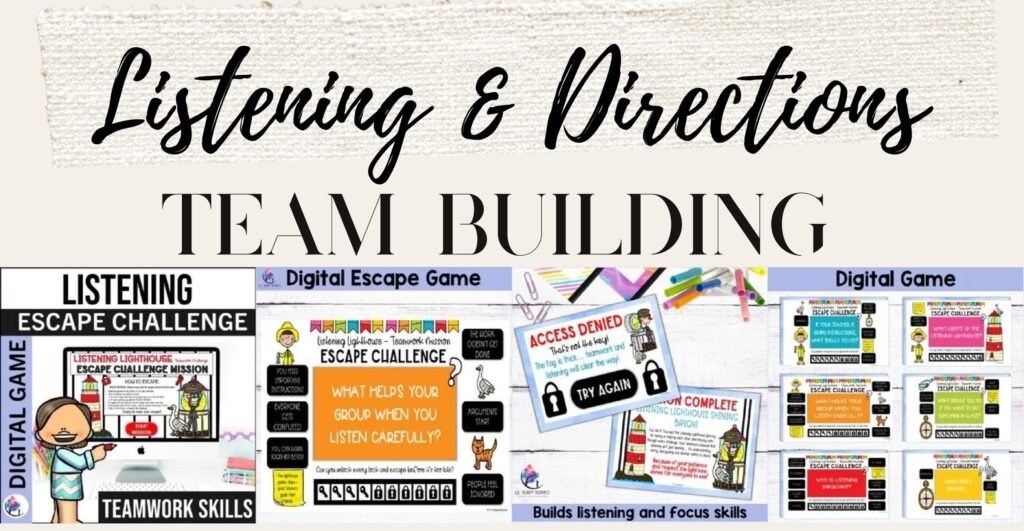
Try this in your next session: Our Listening & Following Directions Team Building Activities turn direction-following into a digital escape challenge, so students practice listening carefully, holding steps in mind and checking their work together. They make a natural follow-up to a worksheet focused on one- and two-step directions, because students hear similar language in an active, social setting.
Build in Scaffolding and Generalization
Children rarely learn receptive language skills in a straight line. A child may understand “under” with a familiar picture but not when the same concept appears in a busy scene or a new setting. This is not failure. It is information about where the skill is established and where additional teaching is needed.
Scaffold by adjusting one variable at a time. Begin with two clear choices before moving to four. Use familiar nouns before unfamiliar ones. Present one-step directions before adding sequence words. Step-by-step directed drawing activities are another natural way to practice this. Offer visuals with spoken directions, then gradually reduce visual supports when appropriate. This approach helps preserve a sense of competence while allowing the task to become more challenging.
Generalization should be planned rather than assumed. If a child practices identifying emotions from facial expressions on a worksheet, connect the skill to a brief role-play, a story character, and real-time check-ins. If the worksheet teaches “before” and “after,” use those words during transitions: “Before we clean up, choose one more item,” or “After you finish your first step, check the next box.” Repeated, natural use gives abstract language a place to live.
For children who use augmentative and alternative communication, ensure that the response format is accessible. They may point, use eye gaze, select symbols, type, or activate a device response. Receptive language work should not depend on spoken output when speech is not the most reliable way for the child to respond.
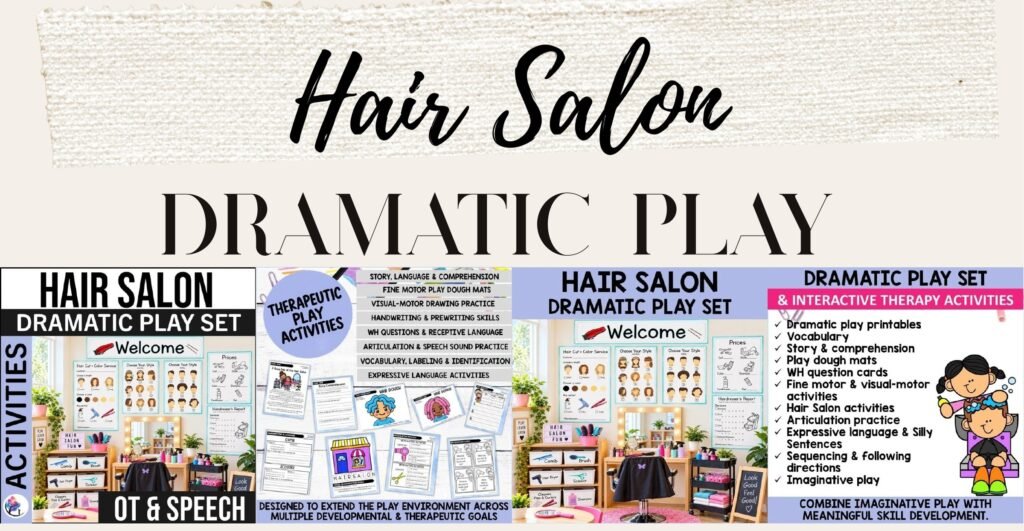
From our therapy room to yours: dramatic play is one of the easiest places to generalize receptive language. Our Hair Salon Dramatic Play & Interactive Therapy Activities give children a familiar role-play setting where adults can embed directions, location words and questions naturally (“Put the brush next to the mirror,” “Who needs the next appointment?”). Because the child is playing a role, practice feels purposeful instead of like another page to finish.
Collect Useful Data Without Losing the Child
A simple record can make worksheets far more informative. Note the target, number of opportunities, level of prompting, response accuracy, and any patterns you observed. “Answered 4 of 5 location-concept items independently with picture choices” communicates much more than “completed worksheet.” If performance changed after a repetition or visual cue, include that detail.
Patterns can guide intervention decisions. Consistent difficulty with wh- questions may indicate a need to teach the meaning and expected response type for each question word. Errors on longer directions may suggest that length, sequencing, or working memory is affecting performance. Research with 7- to 9-year-olds found that children recalled classroom-style instructions better when they acted them out, which is one more reason to pair worksheets with hands-on follow-up. If the child succeeds only when the pictures are highly familiar, expand vocabulary instruction before increasing linguistic complexity.
Avoid overinterpreting one session. Children can have an off day, and worksheet performance does not diagnose a communication disorder or determine eligibility on its own. Federal special education regulations specifically bar using any single measure as the sole criterion. When concerns persist, collaborate within your setting and follow appropriate referral, assessment, and family-communication procedures.
Make the Page Feel Worth Doing
Even the best target can lose value when a worksheet feels repetitive or disconnected from the child. Offer small choices when possible: which page to begin with, whether to use a marker or pencil, or whether to respond by circling, covering, or using picture cards. Keep pages visually clear, especially for children who are easily overwhelmed by dense layouts.
For busy professionals, ready-to-use materials can reduce preparation time while still allowing individualization. A flexible resource can be reused by changing the prompt level, number of choices, mode of response, or real-world follow-up activity. That adaptability is often more useful than a large stack of pages with only one possible use.
The strongest receptive language practice does not end when the worksheet is put away. It continues when a child understands one more direction during group time, follows a calming routine with greater confidence, or recognizes that the words adults use can make the world feel more predictable and manageable.
Frequently Asked Questions
What is receptive language?
Receptive language is how a child understands language, whether it is spoken, signed or written. It includes vocabulary, concepts, directions, questions and grammar.
Are worksheets enough to build receptive language skills?
Not on their own. Worksheets are useful for focused practice and simple data, but they work best alongside play, routines, conversation and the child’s individual speech-language goals.
Which receptive language skills should I target first?
That depends on the child’s assessment and goals. Common early targets include everyday vocabulary, basic concepts such as size and location, one-step directions and simple wh- questions.
How do I take data on receptive language worksheets?
Record the target, the number of opportunities, the level of prompting and the accuracy. A note such as “4 of 5 location items independently with picture choices” is far more useful than “completed worksheet.”
References
- University of Washington: Receptive and expressive language disorders
- AFIRM: Prompting evidence-based practice brief (UNC, 2024)
- Jaroslawska et al. (2016): Following instructions in children (White Rose Research Online)
- British Journal of Educational Psychology: language comprehension and later reading
- IDEA regulations, 34 CFR §300.304 (evaluation procedures)
Looking for practical, ready-to-use resources to support your receptive language goals? The All Therapy Resources Membership provides access to a growing collection of thoughtfully developed counseling activities, interactive games, and therapeutic tools designed to save preparation time while supporting meaningful, skill-focused learning.