
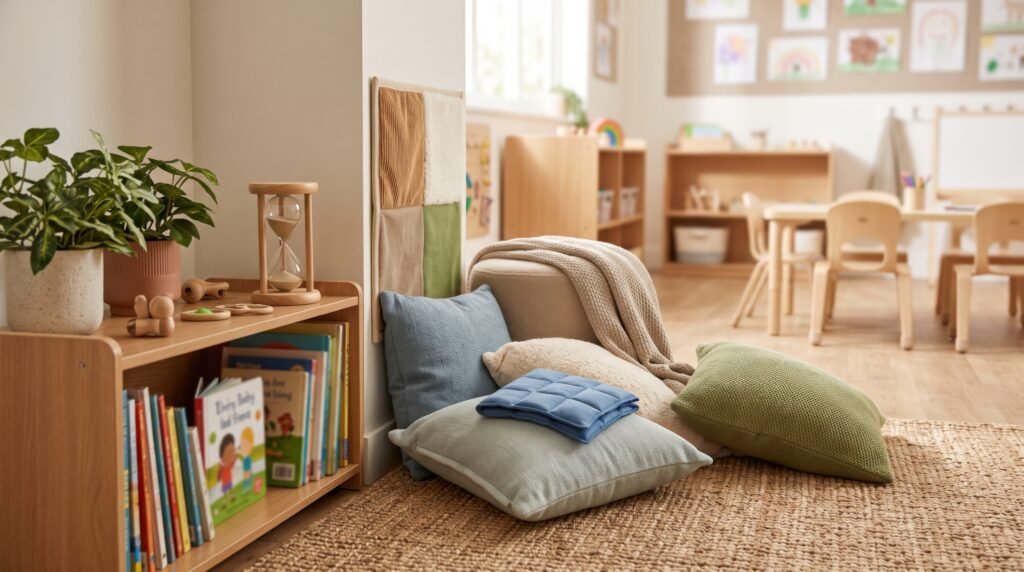
Calm down corners have become increasingly common in classrooms, counseling rooms, special education settings, and therapeutic spaces. They often include feelings posters, breathing exercises, coping strategies, sensory tools, comfortable seating, and visual reminders designed to help children regulate.
But simply having a calm down corner doesn’t teach a child how to calm down. We can create a beautiful space, laminate every poster, fill a basket with sensory tools, and still find that students don’t know what to do when they get there.
The real value of a calm down corner isn’t in having one. It is in teaching children how, when, and why to use it.
Our Calming Corner Toolkit was designed around this idea. It combines emotion identification, body awareness, coping strategies, grounding, breathing exercises, reflection, affirmations, feelings scales, and other visual supports so the space can be actively used to teach regulation rather than simply decorate a classroom.
The Goal Isn’t to Make the Feeling Disappear
One of the first things we need to reconsider is what we actually mean when we tell a child to “calm down.” Emotional regulation doesn’t mean replacing every uncomfortable emotion with happiness.
A child can still feel angry and be regulated enough to communicate safely. They can feel disappointed and remain able to problem-solve. They can feel nervous and still take the next step. They can feel sad and still have enough regulation to tell someone what they need.
If the unspoken expectation of a calm down corner becomes “Come back when you’re happy,” we risk teaching children that some emotions are acceptable and others need to disappear.
Instead, the message should be that all feelings are welcome, and we can learn what to do with them. The Safe Space and emotion visuals within our toolkit reinforce this by helping children recognize and name different emotional experiences rather than judging them as good or bad.
Regulation Begins With Noticing
Before children can choose a coping strategy, they need to notice that something is happening.
A child may not recognize that they’re becoming angry until they’re already yelling. Another may not identify anxiety until they’re refusing to enter the classroom. A student might not recognize overwhelm until they’ve pushed their work away and completely disengaged.
This is why emotional regulation needs to include body awareness as well as emotional vocabulary. We can help children begin noticing the physical clues that often appear before their behavior escalates.
Maybe their hands become tight when they’re angry. Their stomach feels strange when they’re nervous. Their heart beats faster when they’re overwhelmed. They begin moving more quickly, talking louder, withdrawing, or finding it difficult to think clearly.
The Body Clues and Feelings Thermometer resources within our toolkit help children begin connecting emotional experiences with what is happening inside their bodies.
Over time, we’re trying to move that point of recognition earlier. Instead of “I know I was angry because I threw something,” we want to help a child reach “My body is getting tense and my hands are tight. I think I’m getting angry.”
That earlier recognition gives the child something incredibly valuable: time to make a different choice.
Teach the Calm Down Corner When Nobody Needs It
One of the biggest mistakes we can make is waiting until a child is highly dysregulated before teaching them how to use the regulation space.
When a child is already overwhelmed, that’s probably not the ideal moment to introduce a new breathing technique, explain the feelings thermometer, or ask them to choose from eight unfamiliar coping strategies.
The calm down corner should be explicitly taught when students are calm. Our toolkit’s guide emphasizes teaching and practicing the space and its strategies proactively rather than waiting for a crisis.
Introduce the space to the whole class. Show students what the different visuals mean. Practice the breathing exercises together. Explore the coping strategies. Talk about how someone might know they need a regulation break and what they could do when they arrive.
You can even model the process yourself. Explain that you’re noticing your body becoming frustrated, you’re going to pause, identify what you’re feeling, choose a strategy, and then check whether you’re ready to return.
Now the calm down corner isn’t somewhere mysterious that children are sent when something goes wrong. It is a familiar tool they have already practiced using.
Don’t Let the Calm Down Corner Become a Punishment
A calm down corner can very easily become a beautifully decorated time-out chair.
If students are primarily sent there after challenging behavior, they quickly learn what the space really means: “This is where I go when I’m in trouble.”
Once that association develops, the child is much less likely to view the space as somewhere they can voluntarily go when they notice themselves becoming overwhelmed.
The trauma-informed guidance within our toolkit recommends inviting children to use the space whenever possible rather than automatically sending them there as a consequence. It also focuses on developing regulation skills rather than simply expecting a child to “calm down.”
Our language can reflect that purpose. Instead of “Go to the calm down corner,” we might say, “I’m noticing this is getting really hard. Would a regulation break help?” We can still provide boundaries and structure without turning regulation into punishment.
Children Need to Know What to Do When They Get There
Imagine an overwhelmed student arrives at the calm down corner and sits down.
Now what?
If there is no process, they may simply sit there, play with sensory items, avoid the classroom task, become increasingly upset, or wait until an adult tells them they can leave.
A functional regulation space should help a child answer three important questions: What am I feeling? What might help me? How will I know when I’m ready to return?
This is why our Calming Corner Toolkit includes emotion visuals, a feelings intensity scale, body clues, coping choices, breathing exercises, grounding strategies, reflection prompts, and readiness-to-return supports.
The calm down corner stops being somewhere a child simply goes. It becomes a regulation routine they learn to follow.
Not Every Child Calms Down the Same Way
Another common mistake is assuming that strategies adults perceive as calming will work for every child.
“Take some deep breaths.”
That may be extremely helpful for one student and do very little for another.
Some children regulate through movement. Others benefit from sensory input. Another student might prefer writing or drawing. Someone else may find counting, music, stretching, grounding, reading, or holding something comforting more effective.
The Coping Skills section within our toolkit provides different options including breathing, walking, counting, reading, yoga, music, movement, writing, and using a comforting stuffed item.
The important question isn’t “What is the best calming strategy?” It is “What helps this particular child regulate in this particular situation?”
That is something we discover through teaching, observation, practice, and sometimes trial and error.
Teach Children to Match Strategies to Their Needs
Emotional regulation becomes much more useful when children understand that different emotional states may require different strategies.
A child who is restless and highly activated may need movement before they can sit and breathe slowly. A student whose thoughts are racing may respond well to grounding. Another child who feels withdrawn may need connection and co-regulation rather than being sent away to sit alone.
The toolkit includes 5-4-3-2-1 grounding, multiple breathing strategies, body-clue visuals, a feelings thermometer, and Circle of Control activities to provide children with different ways to understand and respond to what they are experiencing.
Over time, we want children to develop their own understanding of what works for them. They begin learning, “When my body feels like this, this strategy usually helps me.”
That is a much more sophisticated skill than simply choosing a random coping card.
Co-Regulation Is Not a Failure of Independence
We often create calming spaces because we ultimately want children to regulate more independently. But independence doesn’t mean withdrawing adult support before the child has developed the necessary skills.
Some children will initially need an adult beside them. They may need help identifying the emotion, noticing body cues, choosing a strategy, slowing down, or making sense of what happened.
Instead of asking an overwhelmed child, “What coping strategy do you want?”, we may initially offer two manageable options: “Would you like to try the breathing card or take a short walk?”
As the child becomes more familiar with their own regulation patterns, we can gradually reduce that support.
Co-regulation can be part of the pathway toward self-regulation.
A Regulation Break Still Needs a Return
We also need to think carefully about what happens after a child has regulated.
If a student learns that asking for the calm down corner means permanently escaping every difficult task, we may unintentionally create another problem.
That doesn’t mean children shouldn’t be allowed to take breaks. It means that a regulation break should generally have a beginning, a purpose, and a return.
The passes included in our toolkit frame the space as a short break designed to help the child’s body and brain feel calm again, use a regulation strategy, and return ready to learn.
Importantly, returning doesn’t necessarily mean returning to exactly the same demand in exactly the same way. The child may need the task broken down, additional support, clarification, a sensory accommodation, or another adjustment.
Regulation gets the child back to a place where we can work out what they need next.
Pay Attention to What Keeps Sending the Child There
A calm down corner can also provide us with valuable information if we’re paying attention.
If the same student needs the regulation space every day during writing, we should become curious about writing.
If another child repeatedly becomes overwhelmed during transitions, we should look more closely at transitions.
If a student regularly needs regulation after lunch, during noisy activities, when working independently, or following interactions with particular peers, those patterns matter.
Instead of continually asking, “How do we get this child to calm down?”, we can begin asking a much more useful question: “What keeps making regulation difficult in the first place?”
Perhaps the task is too difficult. Maybe the environment is overwhelming. There may be anxiety, sensory demands, friendship problems, uncertainty, executive functioning difficulties, communication challenges, or something else happening beneath the behavior.
The calm down corner can support the child in the moment, but it should never stop us from looking at why the child repeatedly needs it.
Reflection Comes After Regulation
Once the child is regulated enough to think and communicate, there can be enormous value in briefly reflecting on what happened.
Our toolkit includes a Let’s Reflect visual that guides children through what happened, how they were feeling, what they noticed in their body, what helped, and what they could try next time.
The timing of that reflection matters. Trying to process the situation while a child is still highly distressed can simply become another demand.
Once they’re ready, however, reflection helps turn one difficult moment into information the child can use next time. We aren’t just reviewing what went wrong; we’re helping them build their own personal regulation plan.
The Real Goal Is for Children to Take the Skills With Them
Ultimately, we don’t want children to become dependent on the physical calm down corner.
The corner is a scaffold.
At first, a child may need the emotion poster to identify how they feel. Later, they may recognize the feeling themselves. Initially, they may need to look through the coping choices. Eventually, they may automatically know that walking helps when their body feels restless.
A student may begin by following a visual breathing exercise in the regulation space and eventually use that same breathing strategy quietly at their desk, in the playground, before a test, or somewhere completely outside school.
That is progress.
The success of a calm down corner shouldn’t be measured by how frequently children sit in it. It should be measured by whether children are gradually developing emotional regulation skills they can use beyond it.
How We Use Our Calming Corner Toolkit
Our Soft Pastel Calming Corner Toolkit was created to help professionals build a functional regulation space rather than simply an attractive classroom display.
It includes multiple naming options such as Calming Corner, Regulation Station, Peace Corner, Calm Down Spot, and Reset Zone, with matching passes so professionals can choose language that works for their particular setting.
The toolkit then provides the practical teaching supports that help children actually use the space, including emotion visuals, feelings intensity scales, body clues, coping choices, breathing strategies and mats, 5-4-3-2-1 grounding, affirmations, Circle of Control, a Feelings Wheel, Worry Parking Lot, reflection prompts, and readiness-to-return visuals.
We don’t expect every child to use every tool. The purpose is to give teachers, counselors, therapists, occupational therapists, and behavior professionals a range of strategies they can explicitly teach, model, practice, individualize, and revisit.
Because the poster itself isn’t the intervention. What we teach the child to do with it is.
A Calm Down Corner Should Build Skills, Not Just Look Calm
A calming corner can absolutely be beautiful, welcoming, and comforting. But that should be the beginning rather than the end.
A genuinely useful classroom calm down corner or regulation station helps children recognize emotions, notice body cues, understand the intensity of their feelings, choose appropriate strategies, ask for support, regulate, reflect, and eventually return to what they need to do.
It should be taught proactively, not introduced for the first time during a meltdown. It should support regulation rather than function as punishment. It should allow for co-regulation while gradually helping children develop greater independence.
Most importantly, it should move us beyond simply telling children to calm down.
We are teaching them to ask: What is happening inside my body? What am I feeling? What do I need? What can I try? Did it help? What might I do next time?
Those are skills children can carry far beyond the classroom.
The calm down corner is simply one place where we can begin teaching them.
Want More Ready-to-Use Emotional Regulation Resources?
Our Soft Pastel Calming Corner Toolkit is included in the All Therapy Resources® Membership, alongside our growing library of ready-to-use counseling, therapy, behavior, SEL, and educational resources.
Inside the membership, you’ll find practical resources for emotional regulation, coping skills, anxiety, anger management, behavior support, sensory regulation, impulse control, executive functioning, social skills, friendship challenges, self-esteem, resilience, trauma-informed support, school counseling, small groups, and much more.
The membership is designed for school counselors, teachers, psychologists, behavior professionals, occupational therapists, speech therapists, social workers, play therapists, and other helping professionals who want resources they can actually implement with the children they support.
Whether you’re creating a classroom calm down corner, developing an individual regulation plan, supporting a child who becomes easily overwhelmed, or proactively teaching emotional regulation skills, our goal is to give you tools that go beyond simply looking good on the wall.
Because we don’t just want children to have access to coping strategies. We want them to understand their emotions, recognize what their bodies are telling them, and learn how to use those strategies when they actually need them.
Join the All Therapy Resources® Membership and explore the complete resource library today.