

Effective articulation therapy involves more than repetitive speech sound practice. For many students, visual cues can provide valuable support by helping them understand how speech sounds are produced and what movements are involved. Articulation cards with visual cues offer a practical way to make speech sound targets more concrete, particularly when verbal instructions or auditory modeling alone are not enough.
When incorporated into individualized speech therapy activities, these visual supports can complement guided practice, encourage active participation, and help students develop greater awareness of their speech production.erbal instructions into concrete, observable targets, which reduces frustration and keeps students engaged.
The Clinical Rationale for Visual Cues in Speech Sound Practice
Visual cues can be a valuable addition to speech sound intervention, particularly for students who benefit from seeing how sounds are produced rather than relying solely on verbal instructions or auditory models. Illustrations of lip positioning, tongue placement, and other articulatory features can help make speech sound targets more concrete and accessible.
When used alongside appropriate modeling, guided practice, and individualized feedback, visual supports may help students develop greater awareness of their speech production and participate more actively in articulation activities. Their effectiveness depends on the student’s individual needs, the speech sound being targeted, and how the cues are incorporated into evidence-informed intervention.
Supporting Speech Production and Motor Planning
Students with speech sound disorders may experience different challenges when learning to produce sounds accurately and consistently. Some students have difficulty recognizing and organizing speech sound patterns, while others experience challenges with planning and coordinating the movements required for speech production.
Visual articulation cues can provide additional support by illustrating tongue placement, lip positioning, and other features of speech sound production. When combined with auditory modeling, guided practice, and individualized feedback, these supports may help students better understand their speech targets.
For students with childhood apraxia of speech (CAS), visual cues may complement evidence-based motor speech interventions but should not replace individualized treatment delivered by a qualified speech-language pathologist.
Reducing Cognitive Load During Speech Practice
Learning to produce speech sounds accurately can require considerable attention and effort, particularly when students are simultaneously processing verbal instructions, monitoring their speech production, and practicing unfamiliar movements.
Visual articulation cues can help make instructions more concrete by providing a consistent reference throughout practice. Rather than relying entirely on spoken explanations, students can refer to illustrations of articulatory placement while working toward their individual speech goals.
When used thoughtfully, visual supports may reduce some of the demands associated with processing verbal instructions and help students focus on specific aspects of speech production. Combining clear visual cues with appropriate modeling, encouragement, and individualized feedback can create a supportive learning experience that respects each student’s pace and needs.
Selecting Articulation Practice Cards SLP Professionals Trust
Not every set of speech sound cards offers the same clinical utility. Choosing resources for how they look rather than how they function often leaves you without the specific features effective intervention requires. What separates clinically accurate visual cue speech cards from generic flashcards is the precision of the oral-motor depiction and its alignment with developmental phonology, not decorative clip art that looks cute but teaches nothing about articulatory placement.
Anatomy-Based Mouth Pictures vs. Abstract Symbols
Generic illustrations often stylize lip and tongue positions in ways that are anatomically impossible or misleading for a child trying to imitate them. Clinically designed visuals depict oral placement or phonemic patterns accurately, giving you a teaching tool that matches what the student sees in a mirror. You need images that show the difference between retracted and protruded tongue positions clearly. Ambiguous symbols just force you to spend session time explaining what the card is supposed to show.
Integrating Phonics and Sound-Spelling Patterns
Speech sound development and literacy skills are closely connected, particularly when students are learning to recognize and produce sounds alongside their written representations. Incorporating phonics into articulation activities can provide additional opportunities to reinforce sound awareness and letter-sound relationships.
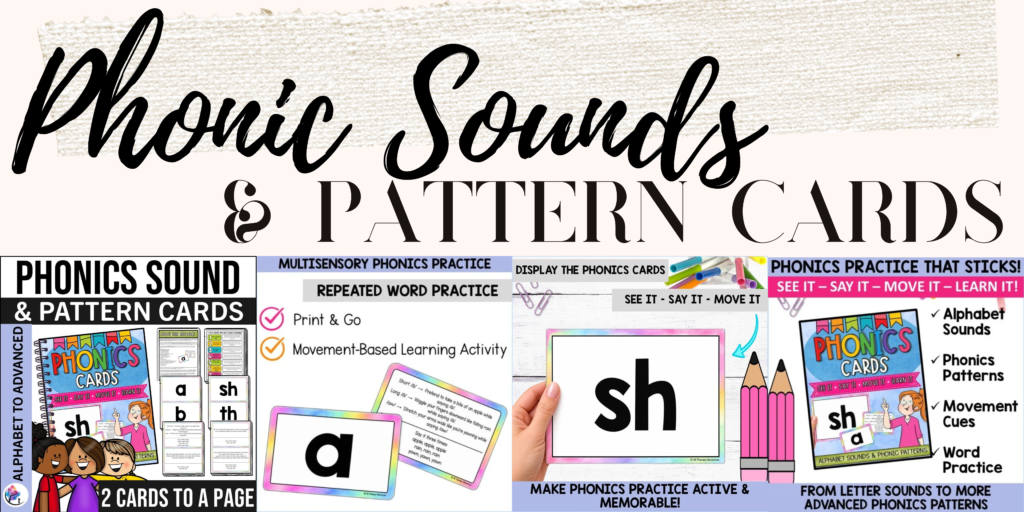
Our Advanced Phonics & Spelling Cards offer a practical way to explore sound-spelling patterns, including digraphs, while supporting engaging, multisensory learning experiences. These activities can complement speech sound practice when aligned with each student’s individual communication and literacy goals.
Supporting Diverse Learners With Visual Learning Supports
Your caseload includes students whose processing differences make purely verbal instruction inaccessible, no matter how skilled your modeling is. Consistent visual anchors help students with autism, language disorders, or attention deficits by giving them predictable structure. That lowers the barrier to participation and keeps the focus on skill acquisition rather than behavioral compliance.
Visual Cues for Neurodivergent Students
Neurodivergent learners often feel heightened anxiety in unstructured verbal exchanges, which is why the predictability of a visual cue system matters for psychological safety. A permanent, non-judgmental reference lets the student check their own progress at their own pace, without feeling pressured to maintain eye contact or decode rapid verbal corrections. This honors neurodivergent processing styles and lets articulation practice proceed without triggering shutdown or avoidance behaviors.
Cultural and Linguistic Responsiveness in Card Design
Visual supports have to reflect the populations you serve to actually work across different cultural and linguistic backgrounds. Inclusive imagery and multilingual options show respect for diverse backgrounds and support generalization across populations. The Aphasia Word Finding Strategies caregiver resource, translated into both English and Spanish, is one example of prioritizing culturally relevant communication over monolingual assumptions. When students see themselves represented in therapeutic materials, engagement goes up, and the message that their identity belongs in the therapy room comes through in every session.
Maximizing Caseload Efficiency With Ready-to-Use Materials
High caseloads leave little room for building custom visuals from scratch, and the hours spent designing, printing, and laminating individual cards compete directly with your ability to deliver direct services. Ready-to-use articulation practice cards cut that prep time out entirely, so you can redirect that energy toward data analysis, collaboration, and adjusting intervention as you go.
Streamlining Session Prep and Data Collection
Standardized visual cue systems create consistency across sessions and providers, which simplifies progress monitoring and makes your documentation easier to defend. You can move from one student to the next without resetting your environment or hunting for customized materials, because the same cards work across multiple targets and age groups. That efficiency adds up over weeks and months, protecting your time in demanding school-based settings.
Tracking Progress Without Adding Administrative Burden
Effective data collection should support clinical decision-making without taking valuable time away from students. Having organized systems for tracking progress, documenting services, and reviewing outcomes can make everyday caseload management more manageable.
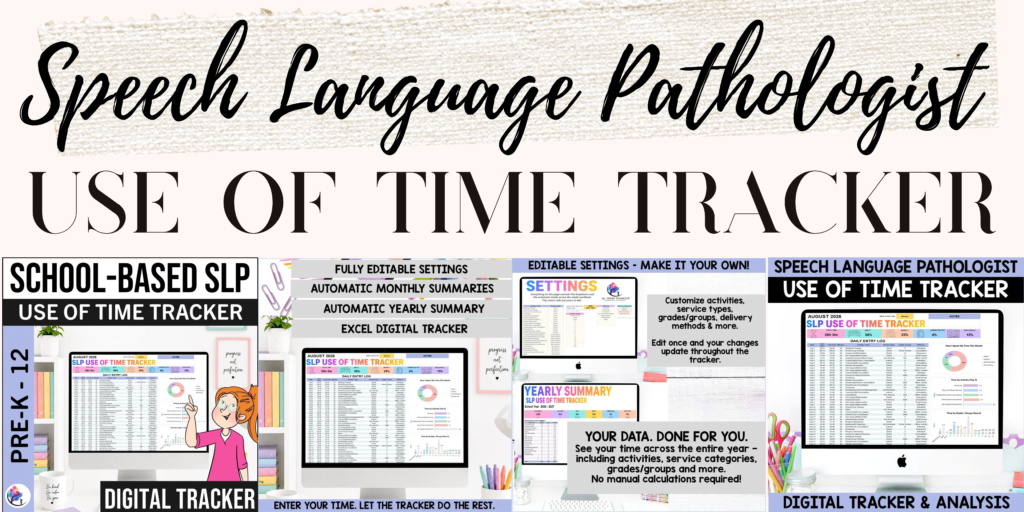
Our School-Based SLP Time Tracker helps speech-language pathologists organize service minutes and streamline documentation, reducing some of the administrative demands of a busy school-based caseload. With practical systems in place, SLPs can spend less time managing paperwork and more time focusing on meaningful student progress.
Beyond Articulation: Building Rapport and Emotional Safety
Therapy materials do relational work too, beyond drilling skills, especially for students with school-based anxiety or trauma histories who associate adult-directed tasks with past failure or coercion. No amount of visual cueing produces accurate motor output if a student’s nervous system is in a state of defensive arousal, which is why rapport-building activities matter just as much as the drills themselves.
Beyond Pretend Play: Using Dramatic Play Sets in Speech and Language Therapy
Dramatic play can offer much more than opportunities for imaginative play. When thoughtfully designed, themed activities can provide meaningful opportunities to address multiple speech and language goals within a single engaging experience.
For speech-language pathologists, incorporating dramatic play into therapy sessions can create opportunities to practice articulation, expressive and receptive language, vocabulary development, comprehension, and social communication while keeping activities purposeful and engaging.
Integrating Articulation, Language, and Comprehension Goals
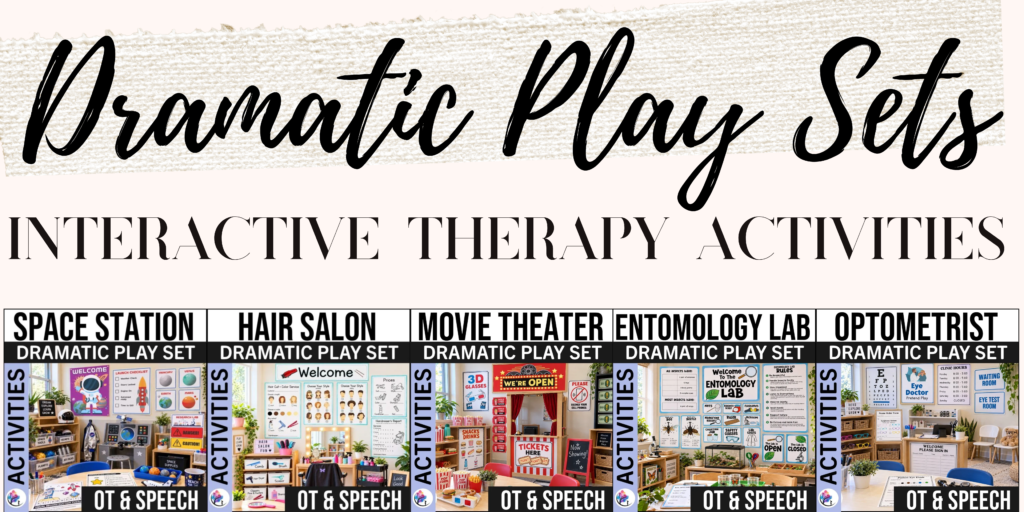
At All Therapy Resources, our Dramatic Play Sets go beyond traditional pretend-play materials. Each themed collection brings together a variety of interactive activities designed to support different therapeutic and learning goals.
Depending on the set, activities may include:
- Articulation and speech sound practice: Themed vocabulary, repeated speech practice, and opportunities to incorporate individual speech sound targets.
- WH questions and comprehension: Question cards, themed stories, and comprehension activities that encourage listening, understanding, and responding.
- Expressive and receptive language: Vocabulary activities, describing tasks, sentence formation, and following directions.
- Social communication: Role-playing scenarios that encourage turn-taking, requesting, conversational exchanges, and cooperative interactions.
- Sequencing and cognitive skills: Activities that support planning, working memory, flexible thinking, and organizing information.
- Fine motor and visual-motor skills: Selected sets also include tracing, drawing, play dough activities, and hands-on learning opportunities.
Bringing Therapy Goals to Life Through Themed Activities
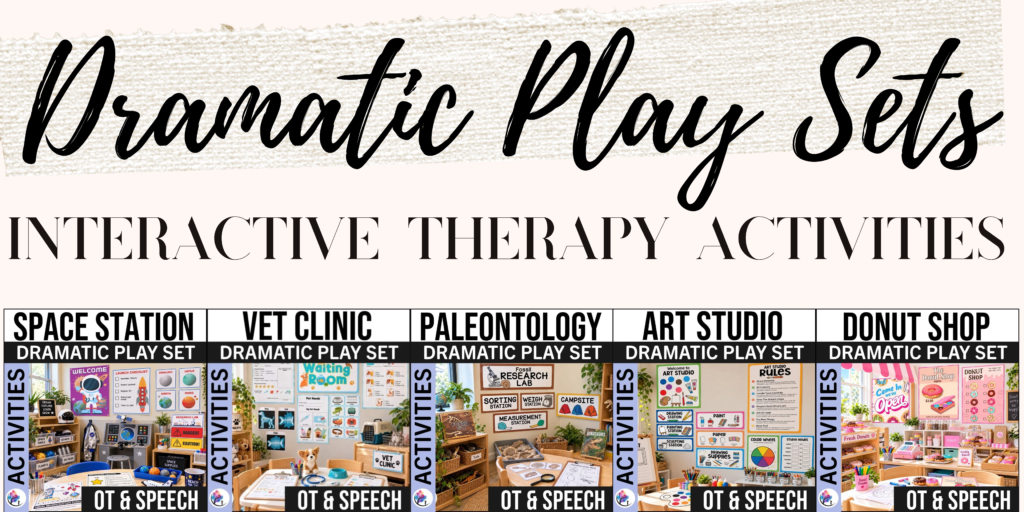
Imagine transforming a speech therapy session into an art studio, veterinary clinic, space station, or donut shop.
Students might practice target speech sounds while naming themed objects, answer WH questions about a story, follow multistep directions during pretend-play activities, or develop expressive language through describing and role-playing.
For example, our Art Studio Dramatic Play Set includes articulation practice, WH question cards, story comprehension activities, expressive language tasks, sequencing opportunities, and fine motor activities alongside its interactive pretend-play materials.
These resources give professionals the flexibility to select activities that align with individual therapy goals while maintaining a consistent, engaging theme.
Explore our Dramatic Play Sets to discover ready-to-use activities that bring speech, language, and other developmental learning opportunities together in creative, practical ways.
Using Interactive Cards to Establish Therapeutic Alliance
Building positive relationships is an important part of creating a supportive speech therapy environment. Before introducing structured articulation activities, taking time to connect with students can help them feel more comfortable, engaged, and willing to participate.
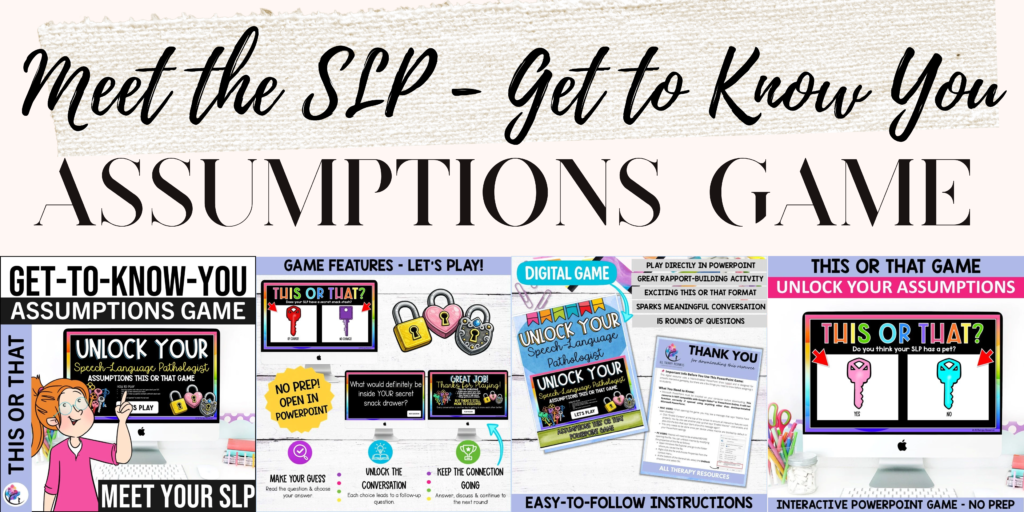
Our Meet the SLP Assumptions Game offers an interactive way for students to get to know their speech-language pathologist while encouraging conversation, curiosity, and connection. Incorporating relationship-building activities into sessions can help establish a welcoming environment where students feel supported as they develop their communication skills.
Implementing Visual Cue Speech Cards Across Settings
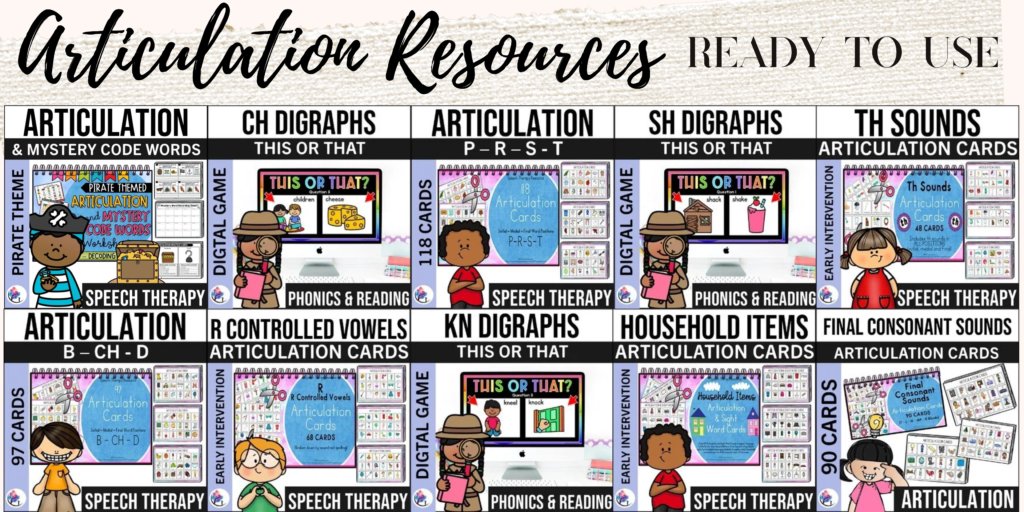
Generalization needs consistency, and switching visual systems across environments fragments a student’s learning and slows progress. Adapting the same articulation cards for individual sessions, small groups, and classroom push-in helps the motor plan transfer beyond the therapy room into functional communication.
Adapting Cards for Small Groups and Classroom Push-In
Small group instruction needs materials that are durable, quick to pull out, and clear enough for several students to reference at once. Visual cue cards work well in these collaborative settings because they give the group a shared reference point, which supports peer modeling and cuts down on how often the teacher has to repeat verbal prompts.
Extending Practice Through Caregiver and Teacher Collaboration
Consistency between therapy sessions, classrooms, and home environments can help students practice and generalize their developing speech skills. Providing caregivers and teachers with clear visual supports and practical strategies creates opportunities to reinforce speech sound targets during everyday interactions.
For students who also benefit from support with emotional regulation, resources such as our Behavior Management Choice Cards can complement communication activities by helping students identify their needs, express preferences, and explore appropriate responses. Combining consistent speech practice with supportive, individualized strategies can help create a more positive and accessible learning experience across settings.
Choosing Evidence-Informed Resources for Your Practice
Selecting articulation materials is a clinical decision that affects student outcomes, not just a purchasing choice driven by budget or convenience. Look for resources that show clinical accuracy, developmental appropriateness, and alignment with trauma-informed principles. Ask whether an option reduces cognitive load and supports student agency, not just whether it looks appealing. Your students deserve tools that honor their dignity and move their progress forward.
Frequently Asked Questions
Why do visual cues improve articulation outcomes when auditory modeling alone is insufficient?
Visual cues can provide additional support for students who find it difficult to understand or reproduce speech sounds through auditory modeling alone. By illustrating tongue placement, lip positioning, and other articulatory features, visual supports can help make speech sound targets more concrete and accessible.
When combined with auditory modeling, guided practice, and individualized feedback, visual cues may help students develop greater awareness of how sounds are produced. Their effectiveness depends on the student’s individual needs, the speech sound being targeted, and the intervention approach being used.
What distinguishes clinically accurate visual cue speech cards from generic flashcards?
Clinically informed articulation cards are designed to illustrate relevant features of speech sound production, such as tongue placement, lip positioning, and airflow. These visuals can help students understand articulatory movements that may be difficult to observe or explain through verbal instructions alone.
While traditional flashcards can be valuable for practicing target words and sounds, visual articulation cues offer an additional reference for speech production. Both approaches can be useful when selected according to individual therapy goals and developmental needs.
How should visual cue systems be adapted for neurodivergent or multilingual learners?
Visual supports should be selected and adapted to reflect each student’s communication preferences, developmental needs, and linguistic background. Some neurodivergent students may benefit from predictable visual references, simplified instructions, and opportunities to practice at their own pace.
For multilingual learners, speech-language pathologists should consider the student’s languages, cultural context, and speech sound patterns across languages. Visual cues should support individualized communication goals while recognizing that differences associated with language variation are not necessarily speech disorders.
In what ways do ready-to-use articulation practice cards improve caseload management?
Ready-to-use articulation cards can reduce preparation time by providing organized materials for practicing speech sound targets across individual and small-group sessions.
Having accessible, reusable resources allows speech-language pathologists to spend less time creating materials and more time planning individualized activities, monitoring progress, and responding to student needs. When paired with appropriate data collection and clinical documentation, these resources can contribute to a more organized and manageable therapy workflow.
What role do rapport-building activities play in effective articulation therapy?
Building positive therapeutic relationships can help students feel comfortable, supported, and engaged during speech therapy sessions. This can be particularly important for students who have experienced frustration, anxiety, or repeated difficulties with speech sound production.
Interactive games, collaborative activities, and play-based experiences provide opportunities for speech-language pathologists to establish trust while learning about each student’s interests, strengths, and communication preferences.
Although rapport-building activities do not replace targeted articulation intervention, they can complement structured speech practice by encouraging participation, motivation, and a positive therapeutic experience.
More Resources. Less Prep. More Time for Your Students.
Great therapy sessions shouldn’t mean spending hours searching for resources or creating materials from scratch.
At All Therapy Resources, we understand how much goes into supporting the students on your caseload. That’s why we’ve created the ATR Membership Library, an extensive and continually growing collection of practical, ready-to-use resources designed to make your planning easier and give you more time for the work that matters most.
From speech and language activities to counseling interventions, behavior supports, social-emotional learning resources, and professional practice tools, there’s always something new to discover.