

Traditional classroom management often rewards compliance over connection. Supporting students with complex trauma histories calls for a different approach entirely. Trauma-informed classroom behavior support tools work as regulatory scaffolds rather than mechanisms for obedience. They start from the premise that behavioral challenges often come from nervous system dysregulation, not willful defiance. When you shift from asking what is wrong with a student to asking what happened to them, the resources you choose have to change too, addressing the physiological need underneath rather than just suppressing the symptom on top.
This distinction matters because standard reward charts and consequence ladders can retraumatize children whose survival strategies get misread as opposition. Educators with 18 years of teaching experience have reported that adopting trauma-informed frameworks meant rebuilding their foundational approach to behavior, not just layering new techniques onto an existing punitive structure. Real safety comes from an environment and a set of materials that communicate predictability and acceptance before a crisis ever starts.
Reframing Classroom Behavior Through a Nervous System Lens
Behavior is communication. For students affected by trauma, it’s often a distress signal from a nervous system stuck in survival mode. Trauma-informed practices give educators specific tools to recognize and address the impact of trauma on student behavior and learning capacity, according to AACTE Ed Prep Matters guidance on mindfulness and trauma support. A student can’t engage cognitively while their brainstem is signaling danger, so regulation has to come before any academic or behavioral expectation.
Traditional resources often assume a baseline of safety that many students simply don’t have when they walk into the building. Effective trauma-informed classroom behavior support tools bridge that gap by offering external co-regulation before asking for internal self-control. This protects your relationship with the student while giving them the physiological stability they need before any skill-building can take hold.
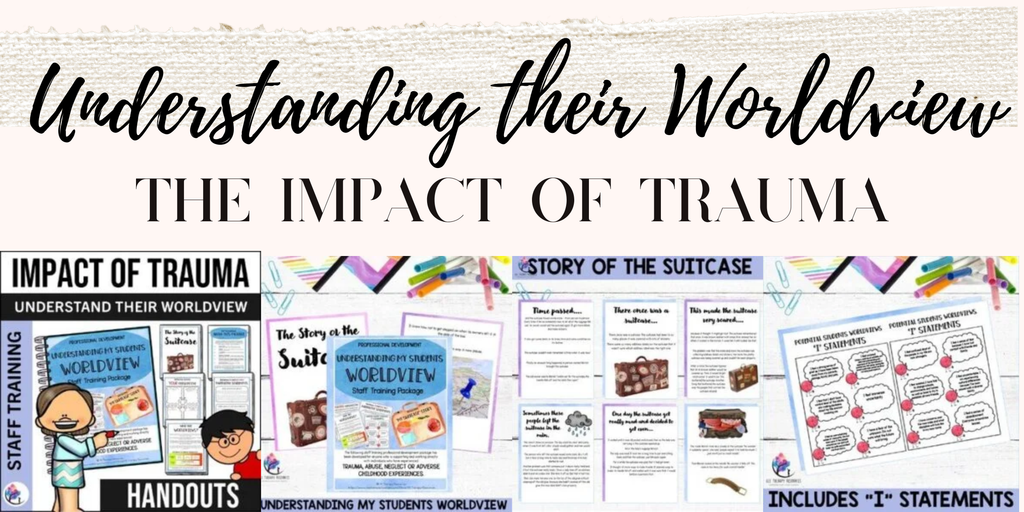
Understanding how trauma influences the developing brain can help educators move beyond managing behavior to recognizing the underlying needs driving it. Our Understanding My Worldview – Trauma-Informed Neuroscience & Attachment Resource explores the relationship between trauma, brain development, emotional regulation, and behavior through accessible explanations and real-life case examples involving children, adolescents, and individuals with intellectual disabilities. Designed for educators, counselors, and helping professionals, this resource provides a deeper understanding of how trauma can shape everyday experiences and why supportive relationships, empathy, and trauma-informed responses matter.
De-Escalation Tools for Classroom Safety and Regulation
Physical environment tools lower cognitive load during moments of acute dysregulation, because they make choices visible and predictable. De-escalation tools need to be practiced during calm states, well before they’re needed, since introducing anything new during a crisis just adds to the overwhelm. How you set up these spaces in advance decides whether they become genuine sanctuaries or just another place to send a child to be alone.
Visual Cues for Calm Down Corners
Visual supports bypass the language centers of the brain, which tend to go offline under high stress. That lets a student reach for a regulation strategy without having to find the words for what they need. Using calm down corner posters and visuals gives a dysregulated student a concrete anchor toward a soothing activity when they can’t articulate anything. These cues work best when they show specific actions, like deep breathing or stretching, rather than abstract emotions, since specificity cuts down on decision fatigue in the moment.
Keeping visual placement consistent helps the brain map safety onto physical space over time. The Center for Resilience in Schools Observation Tool specifically checks whether students get real opportunities to practice regulation skills in the classroom: journaling, deep breathing, self-talk, mini-breaks, exercise.
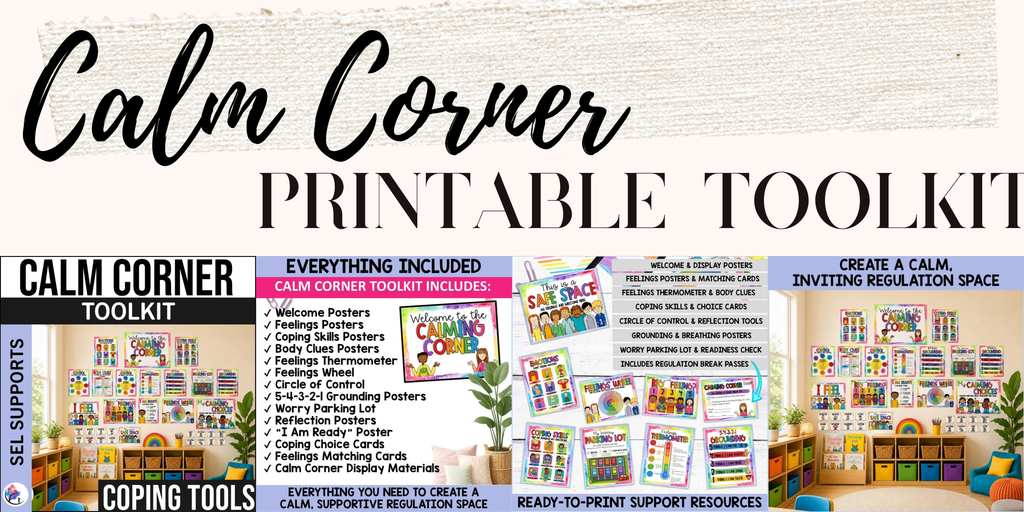
A well-designed calm down corner is more than a quiet space. It’s a supportive environment where children can recognize their emotions, understand their body’s signals, and practice strategies to regulate and return to learning. When introduced proactively and practiced during calm moments, these spaces can help children develop greater emotional awareness, independence, and self-regulation skills. Our Calming Corner Toolkit brings these principles into practice through visual coping strategies, emotion identification tools, grounding activities, breathing exercises, and structured reflection prompts. Rather than simply providing a place to sit when overwhelmed, it helps educators create a predictable, trauma-informed space where children feel supported, understood, and empowered to manage their emotions.
Sensory and Environmental Accommodations
Sensory input directly shapes arousal levels, which makes environmental adjustment a primary intervention rather than an afterthought. Dim lighting, noise-reducing headphones, or weighted lap pads offer bottom-up regulation that speaks to the brainstem directly, without routing through cognitive processing a dysregulated student doesn’t have access to. Introduce these options during regulated states and introduce them neutrally, so students come to associate them with comfort instead of punishment or shame.
Environmental predictability cuts down the hypervigilance that wears out students carrying trauma histories. A small adjustment, a seating change, a transition warning given early, can prevent an escalation more effectively than any consequence delivered after the fact.
Trauma-Informed Behavior Intervention Printable Resources
Printable interventions bridge therapeutic concepts and daily classroom use without demanding hours of prep. Scenario-based cards let students explore regulation strategies through a third-person narrative, which lowers the threat response that direct personal questioning can trigger in traumatized youth. You can use these materials to build connection and skill even when verbal processing feels unsafe or simply out of reach.
Representation in behavioral materials signals belonging. It validates lived experiences that generic resources tend to erase. Culturally responsive printables make sure your materials reflect the actual identities and backgrounds of the students in front of you, rather than imposing one cultural framework on everyone.
Scenario-Based Coping Strategy Cards
Scenario cards externalize the problem. A student gets to analyze coping strategies for a character first, before ever applying them to themselves. Resources like coping strategies for ACEs and displacement walk through complex experiences, including loss and migration, that many students carry silently. Each card poses a question that invites reflection without demanding disclosure, which honors a student’s right to privacy while still offering support.
These tools work because they separate identity from behavior. Struggling doesn’t mean being broken. In one documented inclusion classroom of 14 students, trauma-informed strategies were put into practice to support more personable peer interactions, which suggests that structured scenario work can build community alongside individual regulation skills.
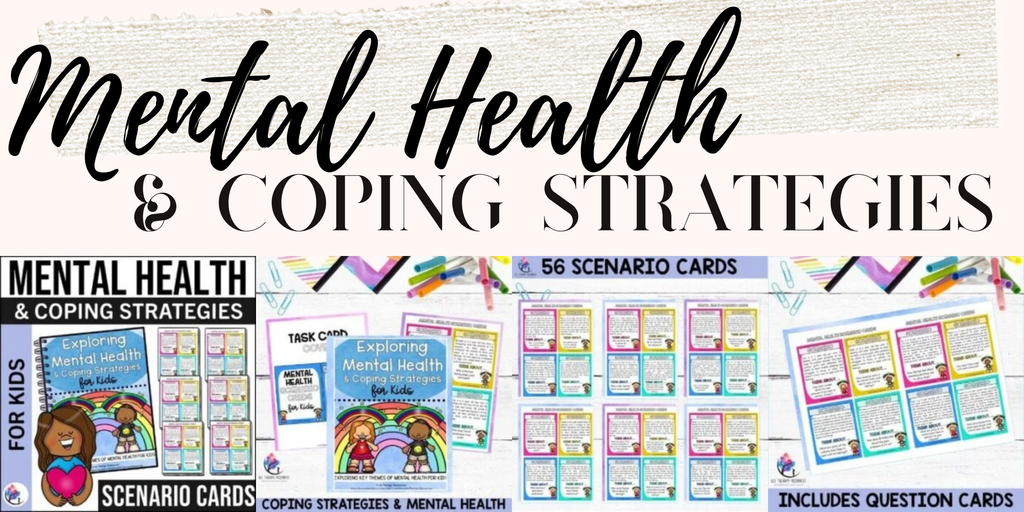
Scenario-based activities provide a safe, engaging way for students to explore challenging situations, consider different perspectives, and develop practical coping strategies without feeling pressured to share personal experiences. Our Coping Strategies Visuals & Mental Health Activities for Kids includes 56 relatable scenario cards exploring anxiety, bullying, grief and loss, peer pressure, family changes, self-esteem, and other mental health challenges. Through guided discussion and reflection, students can build emotional awareness, strengthen problem-solving skills, and identify healthy ways to navigate difficult experiences. These activities can be incorporated into individual counseling, small groups, or classroom SEL lessons.
Culturally Responsive Behavioral Supports
Language barriers compound dysregulation when a student can’t access emotional vocabulary in their home language. Providing Spanish emotional regulation posters gives bilingual students equitable access to calming strategies, without the added cognitive burden of translating while distressed. Cultural responsiveness goes beyond translation, too. It includes imagery, names, and scenarios that mirror students’ actual communities and family structures.
When materials reflect a student’s world, they communicate that the whole student belongs in that classroom. That validation lowers the identity threat that chronically activates stress responses in marginalized learners.
Behavior Support Plan Resources for Data and Consistency
Objective tracking protects against burnout by replacing subjective frustration with real information about patterns and systemic needs. Data collection serves a trauma-informed purpose when it points to environmental triggers and adult response patterns, not just a running list of individual student deficits. You deserve systems that protect your energy while making sure support gets delivered fairly across your whole caseload.
Tracking tools also build accountability for the adults in the system, not only the students receiving services. Consistent documentation shows whether interventions are actually happening as planned, and whether resources go where the need is rather than where the urgency is loudest.
Tracking Use of Time and Interventions
Documenting how you spend your hours protects against the drift that happens when crisis management eats up all your bandwidth. A behavior specialist use of time tracker handles the calculations for you, so you can see exactly where your time goes without manual tallying piling onto an already full plate. That visibility lets you advocate for systemic change using evidence, not just exhaustion.
Time tracking also makes sure proactive, preventative work gets dedicated attention alongside reactive crisis response. Without that data, prevention loses to urgency almost every time, and the cycle of dysregulation repeats for students and staff alike.
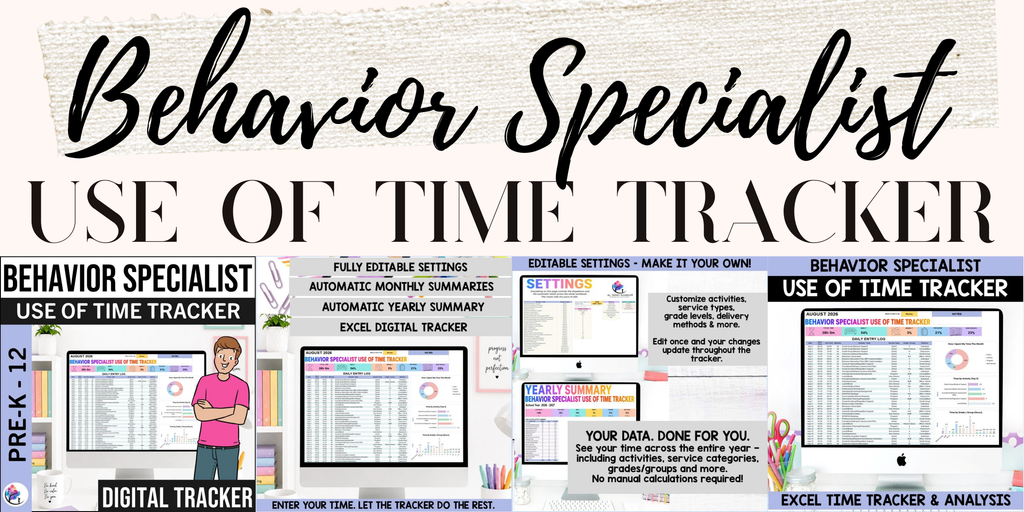
Make Behavior Support Data Work for You
For school-based behavior specialists, managing a demanding caseload often means balancing direct student interventions, behavior observations, crisis responses, consultations, meetings, and administrative responsibilities. Without a consistent tracking system, it can be difficult to see where time is being spent, identify service gaps, or demonstrate the full scope of behavior support services.
Our Behavior Specialist Use of Time Tracker is an automated Microsoft Excel workbook designed to make this process easier. Featuring 12 monthly tracking tabs, customizable service categories, automatic time calculations, visual charts, and a comprehensive yearly summary, it transforms everyday activity records into meaningful, organized data.
Rather than spending valuable time manually calculating hours and percentages, behavior specialists can quickly monitor direct and indirect services, identify patterns in workload allocation, and use their data to inform planning, communicate service needs, and advocate for appropriate support.
Spend less time calculating your data and more time using it to understand, evaluate, and communicate the impact of your behavior support services.
Integrating Data with Compassionate Care
Numbers without context can dehumanize the very students you’re trying to support. Data has to serve the relationship, never replace it. Review your tracking information with curiosity about unmet needs and environmental barriers, not judgment about student compliance or adult failure. How you interpret the data decides whether it becomes a tool for empathy or just another instrument of control.
Compassionate data use means sharing findings with your team to solve problems together, rather than assigning blame. That models something important for students and colleagues alike: mistakes are information, not an indictment of character.
Regulation Strategies for Dysregulated Students via Structured Planning
Adult regulation comes first. It’s a prerequisite for student co-regulation, which makes your own organizational systems a direct intervention in classroom climate. When you work from a place of preparedness instead of chaos, your own nervous system signals safety to students who are finely tuned to adult stress. Regulation strategies for dysregulated students start with the adults in the room modeling the stability they want to see.
Decision fatigue during high-stress moments can undo even well-designed trauma-informed practices. Building scripts and routines into your planning in advance lowers the cognitive load required to respond therapeutically when your own reserves are running low.
Embedding Scripts and Check-Ins into Daily Routines
Having language ready ahead of time keeps you from defaulting to punitive phrasing when you’re stressed or triggered yourself. A school counselor planner with embedded scripts keeps validating responses at your fingertips, so you’re not generating them in real time mid-escalation. Think of these scripts as training wheels for your own nervous system, until trauma-responsive language starts to come naturally.
Scheduled check-ins built into daily routines mean relationship repair doesn’t have to wait for a crisis. Predictable moments of connection build trust far more reliably than reinforcement that only shows up after a behavioral incident.
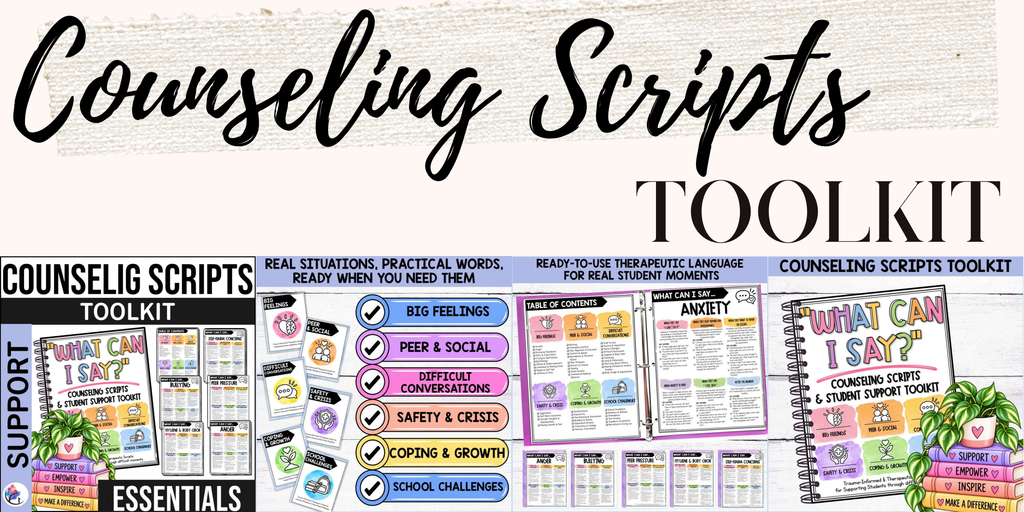
What Can I Say? Practical Trauma-Informed Counseling Scripts for Student Support
Knowing what a student needs is one thing. Knowing exactly what to say in a difficult moment can be another challenge entirely. When a student shuts down, becomes overwhelmed, displays challenging behavior, or shares something concerning, the language we choose can influence whether they feel understood, supported, and safe.
Our What Can I Say? Counseling Scripts & Student Support Toolkit was created to help school counselors, psychologists, social workers, teachers, and mental health professionals navigate these moments with greater confidence. More than a collection of scripted responses, this comprehensive resource combines trauma-informed language, therapeutic guidance, validation statements, reflective questions, and practical conversation prompts to help professionals understand what may be happening beneath a student’s behavior.
From anxiety, anger, and emotional dysregulation to bullying, school avoidance, boundaries, relationship difficulties, and sensitive disclosures, the toolkit provides ready-to-use language for real-world student conversations. Each section encourages connection, emotional safety, accountability, and problem-solving while allowing professionals to adapt responses to individual students and situations. You don’t always have time to find the right words in the moment. Having thoughtful, trauma-informed language ready can make a meaningful difference.
Organizing Caseloads to Prevent Adult Dysregulation
An overextended professional can’t offer the consistent attunement that traumatized students need in order to heal. Organizing your caseload with intention protects your capacity to show up for each student, without sacrificing your own wellbeing in the process. You can’t pour from an empty cup, and sustainable systems have to treat human limits as a professional reality, not a personal failure.
Batching similar tasks and protecting planning time sets boundaries that model healthy self-regulation, because students are watching how the adults around them handle stress. Your organizational habits teach as much as any explicit lesson on emotional management.
Selecting Tools That Align with Trauma-Informed Pedagogy
Not every resource marketed as trauma-informed actually lines up with the principles of safety, trustworthiness, choice, collaboration, and empowerment. You have to ask whether a tool reinforces adult control dressed up as support, or genuinely builds student autonomy and nervous system safety. Audit the materials you already use for implicit bias, punitive framing, or assumptions about neurotypical development that might exclude the students who need support most.
Tools that are truly trauma-informed put connection ahead of compliance and regulation ahead of obedience. They offer more than one path to success instead of a single correct response, treating neurodiversity and cultural variation as strengths rather than something to correct.
Ask whether a resource assumes competence and resilience even while it addresses a deficit area. Materials that focus only on problems, without ever acknowledging strengths, can reinforce a shame narrative that trauma has already written deep.
Building Sustainable Systems for Emotional Safety
Lasting change comes from combining environmental changes, printable interventions, and organizational systems into one coherent approach, rather than deploying isolated strategies here and there. Using trauma-informed classroom behavior support tools consistently matters far more than any single resource’s novelty or appearance. Your sustained commitment to these practices communicates safety more reliably than any poster or worksheet on its own.
Sustainability also means protecting your own capacity, through intentional planning and realistic expectations about how slowly change actually moves. Healing happens in relationships over time, not through flawless technique, so it’s worth extending yourself the same compassion you offer your students.
Frequently Asked Questions
How do trauma-informed behavior support tools differ from traditional classroom management resources?
Trauma-informed tools prioritize nervous system regulation and psychological safety over compliance and obedience. They recognize that challenging behavior often stems from survival adaptations rather than willful defiance, offering external co-regulation before demanding internal self-control. Traditional resources typically assume a baseline of safety that traumatized students may not possess.
What specific de-escalation tools help create psychological safety during behavioral crises?
Visual cues, sensory accommodations, and predictable calm-down spaces reduce cognitive load when language centers go offline during dysregulation. These tools must be introduced and practiced during calm states to build associative safety before crises occur. Environmental predictability and reduced sensory input speak directly to the brainstem without requiring top-down processing.
How can printable behavior intervention resources support non-verbal or dysregulated students?
Scenario-based cards and visual supports bypass verbal processing demands that become inaccessible during high stress. They externalize problems through third-person narratives, reducing threat responses while still teaching regulation strategies. Bilingual materials ensure equitable access for students navigating language barriers alongside trauma.
Why is tracking behavior specialist use of time considered a trauma-informed practice?
Objective time tracking prevents burnout and ensures proactive prevention receives dedicated attention alongside reactive crisis management. It creates accountability for systemic resource allocation rather than solely documenting individual student deficits. This data enables advocacy for sustainable caseloads based on evidence rather than exhaustion.
What criteria should educators use to evaluate if a behavior tool is truly trauma-informed?
Assess whether the tool prioritizes autonomy and safety over adult control and compliance. Check for implicit bias, punitive framing disguised as support, and assumptions about neurotypical development that may exclude diverse learners. Truly trauma-informed resources offer multiple pathways to success and assume competence even while addressing challenges.
Looking for more Practical and Engaging Resources?
At All Therapy Resources, we offer ready-to-use counseling, behavior support, and emotional regulation tools designed to help educators and mental health professionals turn trauma-informed principles into everyday practice.
Explore our Resource Shop or access our growing collection of resources through the ATR Membership Library.