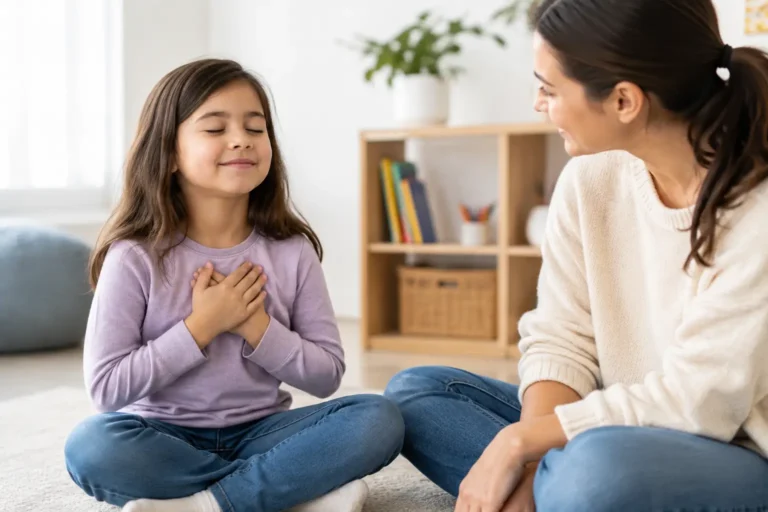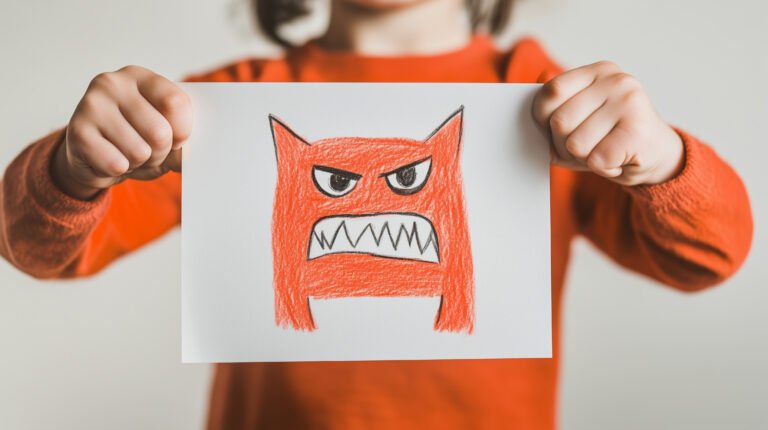


A child who is overwhelmed may not be able to explain what is happening inside. They may go quiet, become silly, argue, leave their seat, or seem suddenly unable to complete a familiar task. Trauma-informed grounding activities for children are not designed to make these responses disappear on command. Instead, they offer a respectful way to help children reconnect with the present moment, recognize safety, and regain enough emotional regulation to choose what comes next.
Grounding is often most effective when it is brief, concrete, and offered without pressure. A strategy that feels calming to one child can feel uncomfortable, activating, or even unsafe to another. The goal is not compliance. The goal is connection, choice, and support.
What Makes a Grounding Activity Trauma-Informed?
Grounding activities are commonly described as techniques that bring attention back to the present through the senses, body awareness, movement, or connection with the environment. A trauma-informed approach changes how the activity is introduced and used.
First, offer choice. Rather than saying, “Take a deep breath,” try, “Would it help to try a movement, notice something in the room, or sit quietly with a fidget?” Children who have experienced stress or trauma may be especially sensitive to feeling controlled. Even small choices can restore a sense of agency.
Second, avoid assuming that a calm-looking body means a regulated nervous system. Some children freeze, fawn, or become very still when distressed. Check in gently and observe patterns over time. Third, keep demands low. Grounding is not a reward a child has to earn before they can access support, and it should not become a consequence for challenging behavior.
Finally, use language that communicates safety without making promises you cannot keep. “You are here with me,” “We can go one step at a time,” and “You do not have to talk right now” are often more helpful than asking a child to explain a difficult experience in the moment.
Trauma-Informed Grounding Activities for Children
The following activities can be adapted for individual counseling, small groups, classrooms, therapy sessions, and home-based support. Introduce them during relatively regulated moments whenever possible. Practicing before a child is distressed makes a strategy more familiar and easier to access later.
1. Find Three Things That Are Steady
Invite the child to look around and find three things that are steady, still, or solid. They might identify a table, the floor, a bookshelf, a wall, or their own feet inside their shoes. If looking around the room feels like too much, they can choose just one object.
This is a useful alternative to sensory prompts that ask children to scan for many details. The focus on steadiness can be especially supportive after a transition, conflict, loud event, or unexpected change. You might say, “Let’s see if we can find one thing that is staying right where it is.”
2. Push, Press, and Notice
Simple resistance activities can provide organizing proprioceptive input without requiring a child to discuss emotions. Offer choices such as pressing hands together, pushing palms against a wall, squeezing modeling dough, holding a chair push-up position, or carrying a small stack of books to a designated spot.
Keep the invitation brief and purposeful. “Would your body like to push against the wall for ten seconds or squeeze this ball?” can feel more accessible than a lengthy exercise. Be mindful of mobility needs, physical limitations, and whether a child dislikes touch or resistance. The child should always be able to stop.
3. Color Hunt With a Choice of Focus
Ask the child to find objects in a color they choose. They may point, name items, make a quick list, or quietly count what they see. In a classroom, a student might look for five blue items from their seat. In counseling, they might choose a color that feels “neutral,” “strong,” or simply “easy to find.”
Color hunts work because they orient attention outward without demanding eye contact or verbal processing. Avoid interpreting the color choice unless the child brings meaning to it. The activity is grounding, not a projective assessment.
4. Create a Five-Item Comfort Kit
A portable grounding kit can help children identify supports before they are in a high-stress state. Items might include a smooth stone, a textured fabric square, a small notepad, a favorite neutral scent if appropriate for the setting, a visual coping card, or a photo or drawing that represents a supportive person, place, or activity.
The most important part is collaborative selection. Ask, “What helps your hands stay busy?” or “What is something that reminds you that you can get through a hard moment?” In school settings, choose items that are quiet, safe, and manageable within classroom expectations. For some students, a single laminated coping card or familiar pencil topper is more practical than a full kit.
5. Use Rhythm Without Requiring Deep Breathing
Rhythm can help children find a predictable pattern when their internal experience feels chaotic. Try gentle tapping on the knees, drumming fingers on a desk, walking to a slow count, or tracing a repeated shape on paper. A practitioner can model a pace and invite the child to join only if they want to.
Breathing exercises are useful for some children, but they are not universal. Focusing closely on the breath can feel uncomfortable or activating, particularly for children with certain trauma histories, panic symptoms, respiratory concerns, or sensory sensitivities. If breath is included, keep it optional and external: “You can notice the air moving, or you can just tap along with me.”
6. Make a Here-and-Now Map
Give the child a simple page with prompts such as: “I am in ___,” “I can see ___,” “I can hear ___,” “One person who can help is ___,” and “The next small thing I need to do is ___.” Younger children may draw rather than write. Older children may prefer to complete the prompts privately and share only what feels comfortable.
This activity supports orientation to place, available support, and the immediate next step. It can be especially helpful when a student is returning to class after a counseling check-in or preparing for a transition. Keep the language present-focused. The purpose is not to revisit the event that caused distress.
Introducing Mindfulness Through Play, Stories, and Creative Activities
There is no single way to introduce mindfulness to children. Some respond well to sensory exploration and movement, while others engage more readily through storytelling, creative activities, and hands-on experiences. The key is finding developmentally appropriate approaches that encourage curiosity, choice, and present-moment awareness without placing pressure on children to feel calm.
In my therapeutic work, I’ve found that introducing mindfulness through familiar, playful experiences can make abstract concepts more accessible. Stories allow children to explore mindfulness through a character’s experiences, while creative activities provide opportunities to practice attention, reflection, and emotional awareness without relying solely on verbal discussion.
Our Sammy the Mindful Sloth – Mindfulness Activities & Craft – Coping Skills Toolbox introduces mindfulness through Sammy the Mindful Sloth, combining therapeutic storytelling, reflective discussion questions, worksheets, and two creative sloth crafts. These activities provide opportunities for children to explore mindfulness in a gentle, engaging way while developing familiarity with present-moment awareness.
For children who enjoy creating something tangible, our Mindfulness Watches Craft & Lesson offers another approach. Children design their own mindfulness watches using meaningful phrases and visual reminders, creating a personalized tool that can prompt them to pause, notice their surroundings, and reconnect with the present moment throughout the day.
Both resources can be incorporated into individual counseling, small-group interventions, or classroom SEL lessons. When introduced with flexibility and sensitivity to each child’s needs, creative mindfulness activities can complement trauma-informed grounding strategies and encourage children to discover approaches that feel comfortable and supportive.
Explore More Mindfulness Activities and Resources for Children
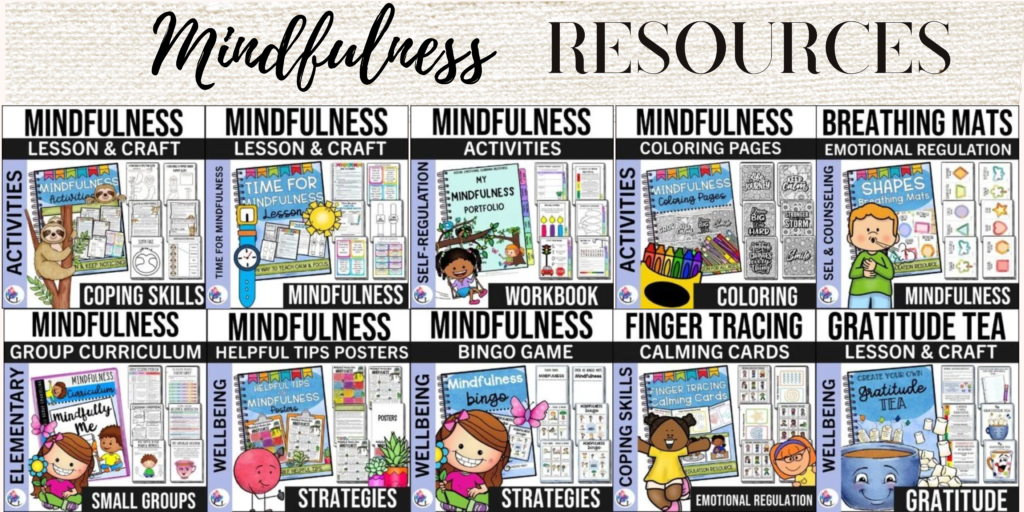
Mindfulness can be introduced in so many meaningful ways, from therapeutic storytelling and creative crafts to mindful coloring, sensory activities, movement, and structured small-group counseling. Offering a variety of approaches allows children to explore present-moment awareness in ways that feel comfortable, engaging, and developmentally appropriate.
At All Therapy Resources, our mindfulness activities include interactive lessons, printable worksheets, calming strategies, therapeutic games, and hands-on activities designed to support emotional awareness, self-regulation, and social-emotional learning.
Explore our Mindfulness Resources Collection to discover practical tools for school counseling, play therapy, individual sessions, small groups, and classroom SEL.
Teaching Grounding Techniques Through Stories and Creative Activities
In my work with children, I’ve found that grounding techniques are often more meaningful when introduced through storytelling, creativity, and hands-on experiences rather than simply asking children to practice a coping strategy.
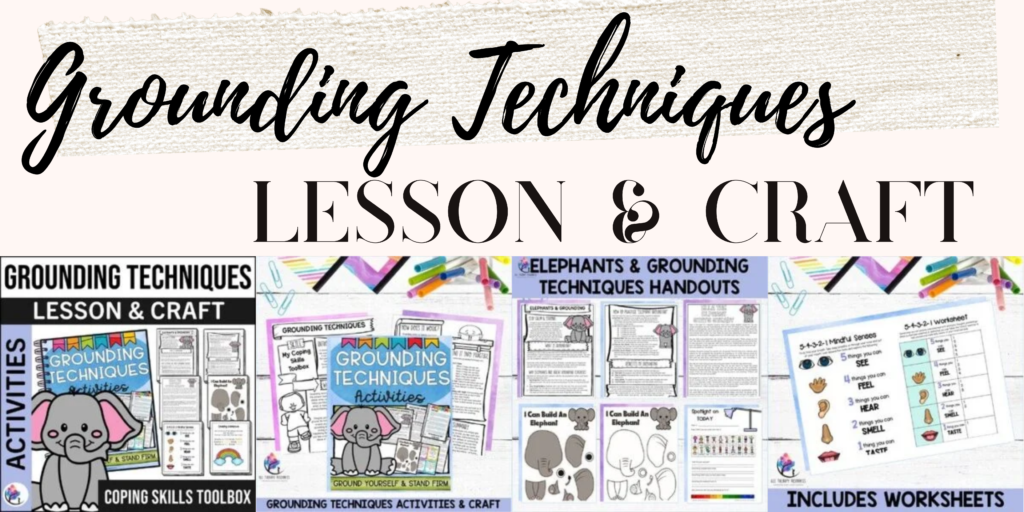
Our Grounding Techniques Activities & Craft – Coping Skills Toolbox uses Ella the Elephant to help children explore what it means to feel grounded, recognize moments of overwhelm, and discover practical ways to reconnect with the present moment.
What makes this approach particularly valuable is that children can explore grounding strategies through a character before applying them to their own experiences. This creates emotional distance, reduces the pressure to disclose personal feelings, and provides opportunities for reflection in a safe, developmentally appropriate way.
The accompanying elephant craft, grounding worksheets, and reflective discussion questions reinforce these concepts through creative expression and active participation. For children who find verbal processing challenging, these activities offer alternative ways to engage, practice, and build familiarity with grounding techniques.
Grounding skills are often easier to access when they have been explored and practiced before moments of distress. By combining therapeutic storytelling with practical activities, this resource helps school counselors, therapists, and educators introduce grounding techniques in a way that emphasizes choice, connection, and emotional safety.
How to Introduce Grounding Without Escalating the Moment
The way an adult offers an activity matters as much as the activity itself. A calm voice, adequate personal space, and brief language can reduce pressure. Instead of asking, “Why are you acting like this?” try, “Something seems hard right now. We can pause.” Instead of insisting on a coping skill, offer two realistic options: “Would you rather sit near the door for a minute or take a short walk with me?”
Children also need permission to decline. A refusal is information, not failure. If a child says no to a sensory tool, movement break, or visual prompt, consider whether they need less language, more distance, a familiar adult, water, food, access to the restroom, or simply time. Regulation support should respond to the child, not force the child to fit a preset routine.
For children with communication differences, build in nonverbal ways to choose. A visual menu, choice board, gesture, or numbered card can reduce the demand to explain. Speech-language and occupational therapy-informed perspectives are particularly helpful here: the child may need a different communication pathway or sensory option, not more verbal prompting.
Build Grounding Into the Environment, Not Just the Crisis Plan
A calm corner, counseling office, or classroom regulation space is more effective when children know what it is for before they need it. Teach the available tools, model how to use them, and clarify that the space is for regrouping rather than punishment. Predictable access matters. If a child can only use a grounding tool after an adult decides their behavior is severe enough, the tool may become associated with shame or discipline.
Creating a Trauma-Informed Calm Corner for Grounding and Regulation
In my work with children, I’ve found that a calming space is most helpful when it is introduced as a supportive environment rather than somewhere children are sent when their behavior becomes challenging. Children benefit from knowing that regulation tools are available before they become overwhelmed, and that accessing support is not dependent on reaching a particular level of distress.
Our Calm Corner Toolkit was developed with this understanding in mind, bringing together visual supports, grounding techniques, emotional awareness activities, and practical regulation tools that can be incorporated into classrooms, counseling offices, and therapeutic spaces.
What makes this approach particularly valuable is the opportunity to teach regulation skills proactively. For example, children can use the feelings thermometer and body clues visuals to begin recognizing early signs of dysregulation, while the coping skills choice cards and 5-4-3-2-1 grounding visual provide concrete options for reconnecting with the present moment.
Rather than expecting children to independently identify what they need during distress, these visual supports can be introduced, modeled, and practiced during calmer moments. Over time, this familiarity may help children recognize their needs, communicate preferences, and access strategies with greater confidence.
A trauma-informed calm corner is not simply a place to calm down. It is an opportunity to build emotional awareness, choice, connection, and self-regulation skills within an environment where children feel supported.
Consider documenting which grounding strategies children select, the conditions in which they use them, and what appears helpful. These observations can inform collaborative planning with caregivers, teachers, and other professionals.
Grounding is not a replacement for individualized mental health treatment, safety planning, or comprehensive assessment when needed. When children experience ongoing distress, functional decline, or safeguarding concerns, follow appropriate professional protocols.
Ultimately, meaningful grounding support often looks ordinary: a trusted adult offering a choice, a child finding their feet on the floor, or a small next step that feels manageable. These moments communicate an important message: support is available, their experiences matter, and they do not have to navigate difficult moments alone.
Supporting Grounding and Emotional Regulation in Practice
Grounding strategies are most effective when children have opportunities to explore and practice them in safe, supportive environments. Having accessible, developmentally appropriate tools can help school counselors, therapists, and educators introduce coping skills, support emotional regulation, and encourage children to recognize what helps them feel grounded.
At All Therapy Resources, we’ve developed a collection of practical, therapy-informed resources to support emotional regulation, grounding techniques, coping skills, and trauma-informed practice.
Explore our emotional regulation and grounding resources to discover ready-to-use activities, visual supports, and therapeutic tools for individual counseling, small groups, and classroom settings.