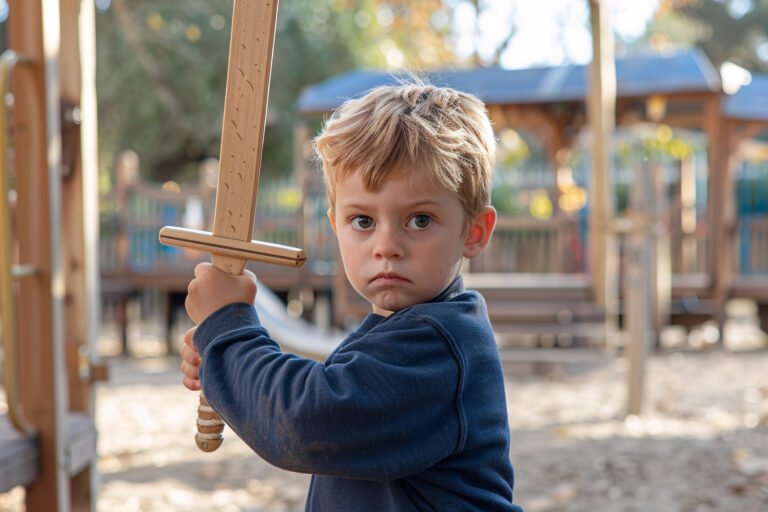

Have you ever taught a beautiful kindness lesson… only to see the same unkind behavior pop up again on the playground an hour later?
You’re not alone.
Most students can tell you that kindness matters. They can define empathy. They can even list “kind words.” But when emotions run high, frustration builds, or social pressure kicks in, that knowledge doesn’t always transfer into real-life behavior.
That’s because kindness isn’t just a concept to teach. It’s a skill set to practice, model, and wire into the brain through repeated, meaningful experiences.
As a counselor and therapist, I’ve learned that the most effective kindness lessons are the ones that move beyond discussion and into experience. When students see kindness, feel kindness, and practice kindness in concrete ways, we start to see genuine shifts in behavior and classroom culture.
Below are some of my most-used kindness activities and lessons — the ones I return to year after year because they don’t just “teach kindness”… they help students internalize it.
Start With Story: Why Kindness Needs to Be Seen Before It’s Practiced
One of the first things I’ve learned in my work with younger students is this: we can’t expect children to demonstrate kindness if they don’t have a clear, concrete understanding of what it actually looks like.
That’s where social narratives become incredibly powerful.
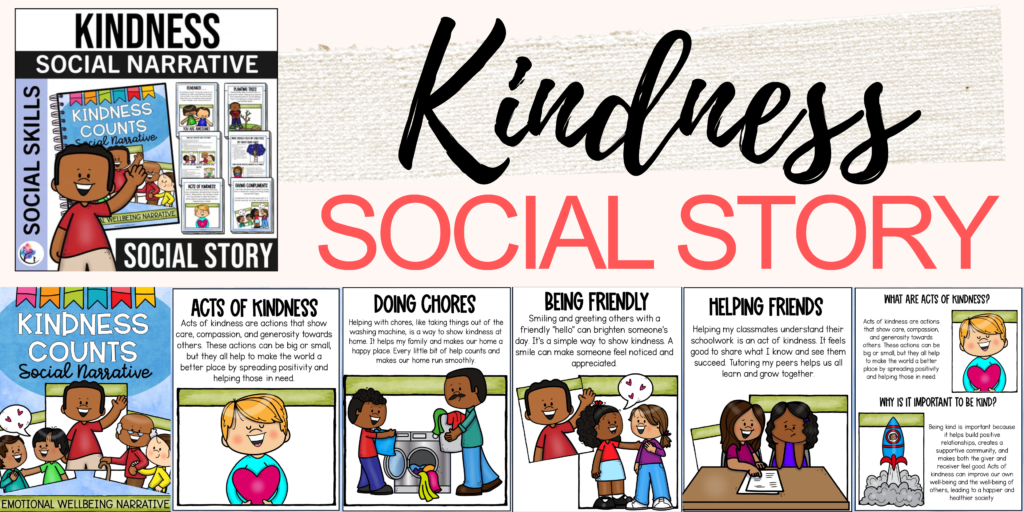
When I introduce kindness through a structured social narrative, I’m not just reading a story — I’m helping students build a mental model of prosocial behavior. Research in developmental psychology shows that storytelling activates mirror neurons, allowing children to mentally rehearse social behaviors before they try them in real life. This process strengthens empathy pathways and supports emotional regulation.
Using a kindness-focused social narrative allows students to:
• See relatable scenarios of kind and unkind behavior
• Understand the emotional impact of their choices
• Build perspective-taking skills
• Develop language for empathy and connection
I’ve used this approach with students who struggle socially, students with emotional regulation needs, and even entire early-years classes. The consistency of language and visual storytelling helps kindness move from an abstract idea to something tangible and repeatable.
Once students can see kindness clearly, they’re far more ready to practice it.
Teaching the Power of Words: Helping Students Feel the Impact of Language
If there’s one lesson that consistently creates powerful “lightbulb moments” for students, it’s teaching them how their words affect others.
Many children genuinely don’t realize the emotional impact of what they say. They may repeat phrases they hear online, at home, or from peers without understanding the weight those words carry. This is where explicit teaching around language becomes essential.
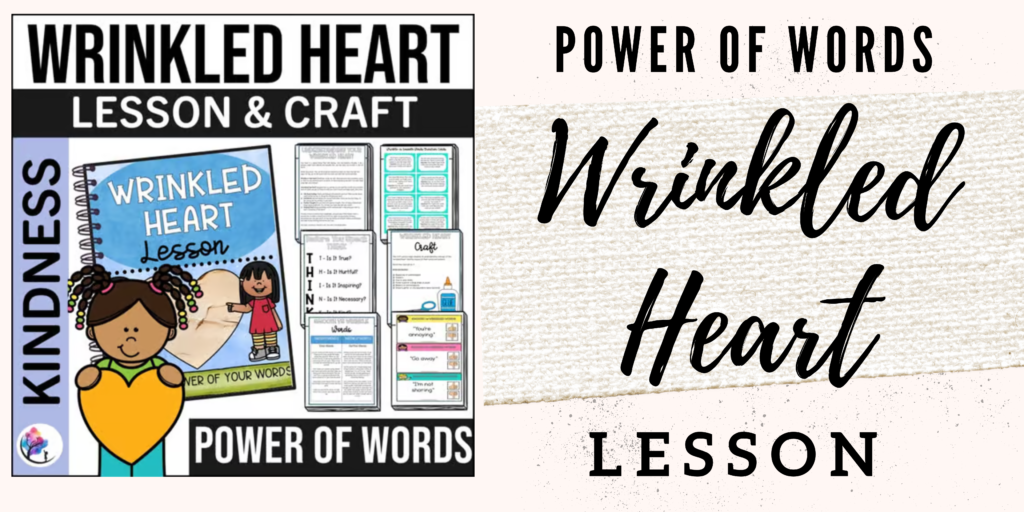
In my sessions, I often introduce activities that compare kind words and hurtful words in concrete, visual ways. When students can physically see or feel the difference between encouraging language and harmful language, the lesson becomes memorable.
Neuroscience supports this approach. Emotional experiences paired with visual or tactile learning activate stronger memory encoding in the brain. This means students are more likely to remember and apply what they’ve learned when they encounter similar situations later.
When we explore the impact of words intentionally, students begin to:
• Pause before speaking
• Reflect on how others might feel
• Recognize the long-term impact of repeated language
• Take ownership of their communication choices
These are the moments when kindness shifts from being teacher-directed to internally motivated.
Creating a Culture of Kindness Through Shared Experiences
One-off kindness lessons can be helpful, but sustained change happens when kindness becomes part of the classroom or counseling culture.
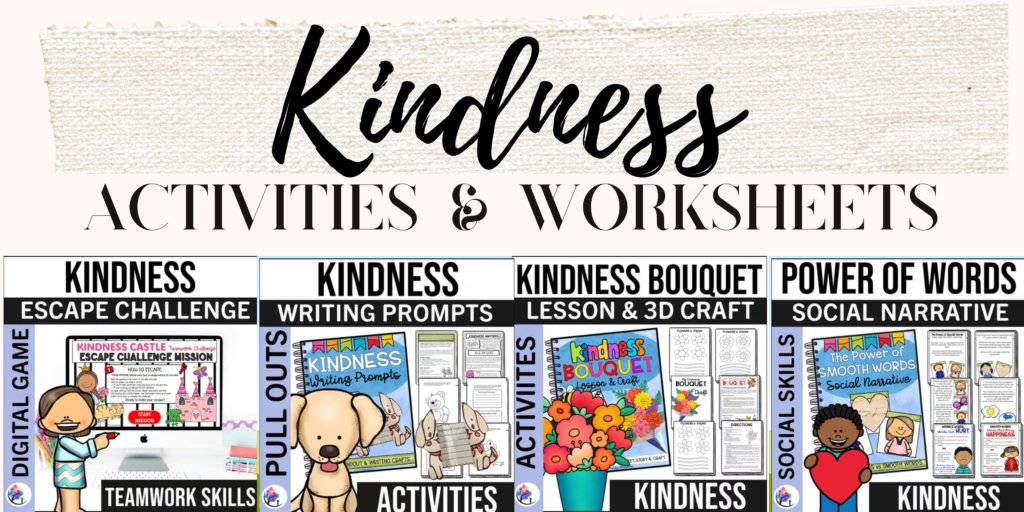
Over the years, I’ve found that collaborative kindness activities are some of the most powerful tools for building this culture. When students work together to create something that represents kindness, they begin to see themselves as contributors to a positive community.
From a psychological perspective, this taps into belonging and social identity theory. When children feel they are part of a group that values kindness, they are more likely to adopt and maintain those behaviors themselves.
Simple but meaningful collaborative activities can:
• Encourage peer encouragement and positive reinforcement
• Build classroom connection and trust
• Increase emotional safety
• Strengthen student voice and reflection
I’ve seen even the most hesitant students begin participating when kindness becomes something the whole group is working toward together rather than an individual expectation.
Helping Students Move From Knowing Kindness to Practicing It
One of the biggest gaps I see in social-emotional learning is the difference between knowing and doing.
Students often know what kindness is. The challenge is helping them apply it consistently in real-world situations — during conflict, frustration, or social uncertainty.
This is where structured reflection and writing activities can be incredibly effective.
When students write about kindness, reflect on scenarios, or create messages for others, they engage the prefrontal cortex — the part of the brain responsible for decision-making, empathy, and self-regulation. Writing slows thinking down and allows students to process their choices more intentionally.
In my own practice, I’ve used kindness writing and reflection activities to help students:
• Consider how their actions affect others
• Generate their own examples of kindness
• Build emotional vocabulary
• Strengthen perspective-taking
• Practice positive self-talk
Over time, these small reflective moments build neural pathways that make kind responses more automatic.
Why Hands-On Kindness Activities Work So Well
We know from both educational and neuropsychological research that experiential learning creates stronger retention than passive learning.
When students create, build, draw, write, or role-play kindness, they are engaging multiple areas of the brain simultaneously. This multi-sensory engagement strengthens neural connections and increases the likelihood that the behavior will transfer into real life.
Hands-on kindness activities also:
• Support emotional expression
• Reduce anxiety by providing structure
• Increase engagement for reluctant learners
• Provide visual reminders of positive choices
• Reinforce repetition (which builds neural pathways)
I’ve seen students proudly revisit kindness crafts or displays weeks later, reminding themselves and others of the values they explored. These visual anchors help kindness remain present long after the lesson ends.
The Real Goal: Creating Emotionally Safe, Connected Classrooms
At its core, kindness education isn’t just about being “nice.” It’s about building emotionally safe environments where students feel seen, valued, and connected.
When students feel safe and connected, their nervous systems regulate more easily. They are more open to learning, more receptive to feedback, and more capable of forming healthy relationships. Kindness becomes both the foundation and the outcome of that safety.
As counselors, educators, and therapists, we have the opportunity to intentionally create these environments through the lessons and experiences we offer.
And when kindness is taught through meaningful, repeated practice — not just posters or slogans — we begin to see genuine, lasting change.
Bringing It All Together
If you’re looking to build a strong culture of kindness in your classroom, counseling space, or home, the key is consistency and intentional practice.
Use stories to build understanding.
Use language-based lessons to build awareness.
Use collaborative activities to build connection.
Use reflection to build internal motivation.
Over time, these experiences shape not just behavior — but identity. Students begin to see themselves as kind, capable, and connected individuals.
Get the Tea with Angie: What Actually Works
Can I just say something gently?
If you’re trying to teach kindness — you’re already doing something incredibly important.
It’s not easy. Some days it feels like you repeat yourself over and over. Some days the playground dynamics undo your beautifully planned lesson in five minutes. I see you.
So here’s what I’ve learned from years of supporting children, families, and school communities. Not theory. Not Pinterest-perfect. Just what actually works.
- Kindness takes repetition — and that’s normal.
If students need reminders, that doesn’t mean your lesson failed. It means their brains are still wiring the pathway. Repetition is not weakness. It’s how learning happens. - Dysregulation isn’t defiance.
When a child is overwhelmed, their nervous system is in survival mode. Empathy is harder to access in that state. Calm first. Connection first. Kindness follows. - “Be kind” is too big — show them how.
Children need to see what kindness looks like in real scenarios. When we break it down, model it, and practice it, it becomes doable. - Words build identity.
When students hear themselves say kind things, they begin to believe, “That’s who I am.” Identity grows quietly through repetition. - Small moments matter more than big assemblies.
A two-minute reflection. A compliment circle. A quick repair conversation. These tiny interactions are often what shape culture. - Emotional experiences stick.
When students feel the impact of their words — through stories, visuals, or reflection — the learning anchors more deeply in the brain. - Belonging changes behavior.
Some of the children who struggle most with kindness are often the ones who feel least connected. When we build belonging intentionally, behavior often softens. - Repair is powerful.
We don’t need perfect children. We need children who know how to say, “I’m sorry,” and try again. That’s resilience. - Modeling matters more than scripting.
Children are watching us more than they are listening to us. When we respond with steadiness and respect, they absorb it. - You are shaping culture — even when it feels invisible.
Every time you pause, redirect gently, and reinforce kindness, you are helping wire prosocial patterns in growing brains. It may not always be loud progress. But it is real.
If kindness feels slow, messy, or imperfect — that’s because real growth is slow, messy, and beautifully imperfect.
Keep going.
Connection changes everything.
Want Ready-to-Use Kindness Lessons That Actually Work?
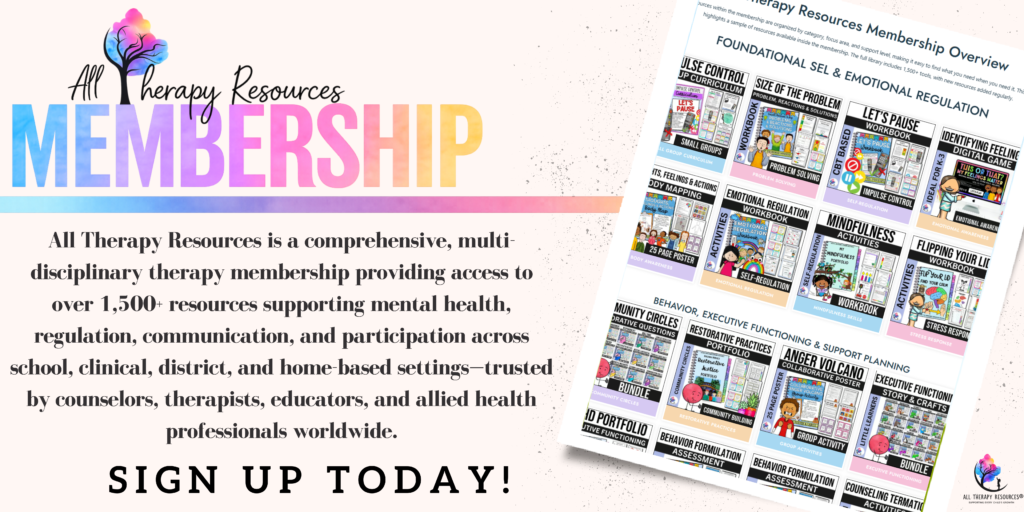
If you’re looking for low-prep, meaningful kindness lessons you can use immediately with students, you can explore the full collection of kindness-based resources inside the All Therapy Resources membership.
Members receive access to a growing library of social-emotional learning tools, counseling lessons, crafts, social narratives, and evidence-informed activities designed to support real behavioral change — not just surface-level lessons.
These are the exact types of resources I use in my own sessions and counseling programs to build empathy, emotional awareness, and positive classroom culture.
You can explore the membership and see everything included here.
Frequently Asked Questions
How often should kindness lessons be taught?
Kindness should be reinforced consistently rather than as a one-time lesson. Short, regular activities integrated into classroom or counseling routines tend to be most effective.
Are kindness lessons still appropriate for older students?
Absolutely. While activities may look different, older students benefit greatly from explicit teaching around empathy, communication, and social responsibility.
Can kindness lessons help reduce behavior issues?
Yes. When students feel connected and understand the impact of their actions, we often see reductions in conflict, bullying behaviors, and emotional outbursts.
Do kindness activities work for students with additional needs?
Structured, visual, and experiential kindness lessons can be particularly helpful for students with social communication or emotional regulation challenges.
Where can I find ready-to-use kindness counseling resources?
You can explore the full kindness collection and hundreds of additional SEL, counseling, and therapy resources inside the All Therapy Resources membership.