

Have you ever worked with a student who knows what to do… but in the moment, just can’t do it?
They can explain the rules.
They can tell you the strategy.
They can even reflect after the situation.
But during the moment?
Impulse takes over.
Emotion escalates.
Logic disappears.
If you’ve seen this—and I know you have—this isn’t a motivation issue.
It’s a neurodevelopmental and regulatory issue.
And this is exactly why teaching students about their brain is one of the most powerful, evidence-based shifts we can make in Social Emotional Learning.
Why Understanding the Brain Is Foundational to Behavior Change
From a psychotherapy perspective, behavior is never random.
It is the output of an internal system involving:
- Cognitive processes (thoughts, beliefs, interpretations)
- Emotional states (affect, arousal, regulation)
- Neurobiological responses (brain activation, stress response systems)
In Cognitive Behavioral Therapy (CBT), we understand that:
Thoughts → Emotions → Behaviors → Consequences
But here’s what’s critical:
Students cannot effectively interrupt this cycle if they don’t understand it.
When we explicitly teach students how their brain works, we are building metacognition—the ability to think about their own thinking.
And metacognition is strongly linked in research to:
- Improved self-regulation
- Increased problem-solving
- Greater emotional awareness
- Better academic outcomes
The Neurobiology Behind Emotional Dysregulation
Let’s ground this in neuroscience.
When a student perceives a threat (social, emotional, or environmental), the amygdala activates rapidly. This triggers the body’s stress response system (fight, flight, or freeze).
At the same time:
- The prefrontal cortex (responsible for reasoning, impulse control, and decision-making) becomes less accessible
- The limbic system dominates processing
- Cortisol and adrenaline increase
This is often referred to as an amygdala hijack.
From a clinical standpoint, this explains why:
- Students act before thinking
- They struggle to access learned strategies
- Their responses appear disproportionate
They are not choosing dysregulation.
They are experiencing it.
And this is where psychoeducation becomes essential.
Psychoeducation as an Evidence-Based Intervention
In psychotherapy, psychoeducation is not just informative—it is therapeutic.
Teaching clients (and students) about how their brain and emotions work:
- Reduces shame (“There’s nothing wrong with me”)
- Increases insight
- Builds internal language for experiences
- Improves engagement in intervention
Research across CBT, trauma-informed therapy, and SEL consistently shows that when individuals understand their internal processes, they are more likely to:
- Engage in regulation strategies
- Demonstrate behavioral change
- Develop long-term coping skills
In schools, this translates to something powerful:
Students begin to move from reactive to reflective.
Why Interactive, Game-Based Learning Enhances Therapeutic Outcomes
Now let’s talk about delivery—because this matters just as much as content.
We know from educational psychology and cognitive science that learning is more effective when it is:
- Active rather than passive
- Social rather than isolated
- Experiential rather than abstract
Game-based learning taps into:
- Dopamine pathways (motivation and reward)
- Sustained attention
- Emotional engagement
- Memory consolidation
From a therapeutic lens, this is critical.
Because when students are engaged:
- They are more open to reflection
- They process information more deeply
- They retain and apply skills more effectively
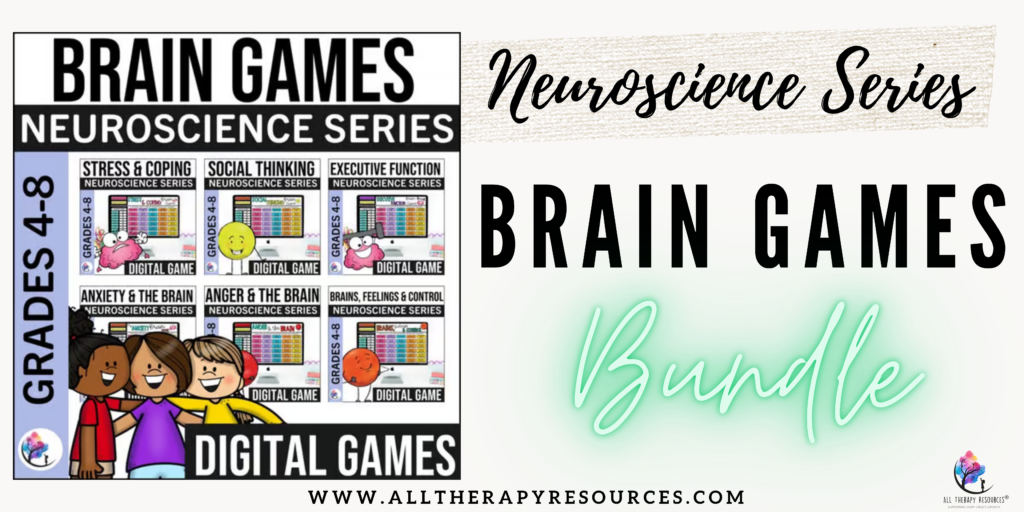
This is why I am such a strong advocate for interactive neuroscience-based SEL games.
They don’t just teach concepts—they create experiences.
A Whole-Brain Approach to SEL: What Students Actually Learn
When we integrate neuroscience, CBT principles, and interactive learning, we are not just teaching “emotions.”
We are building a comprehensive internal framework.
Students begin to understand:
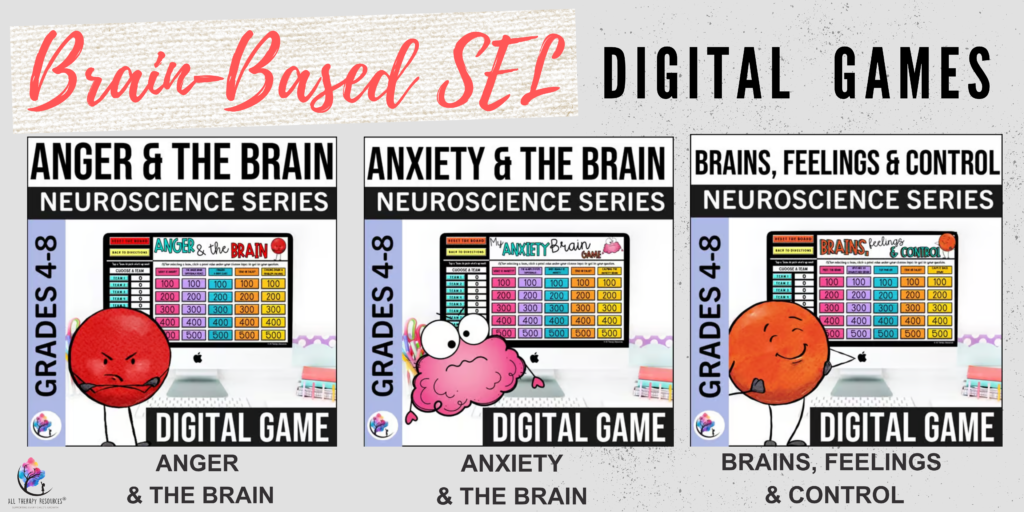
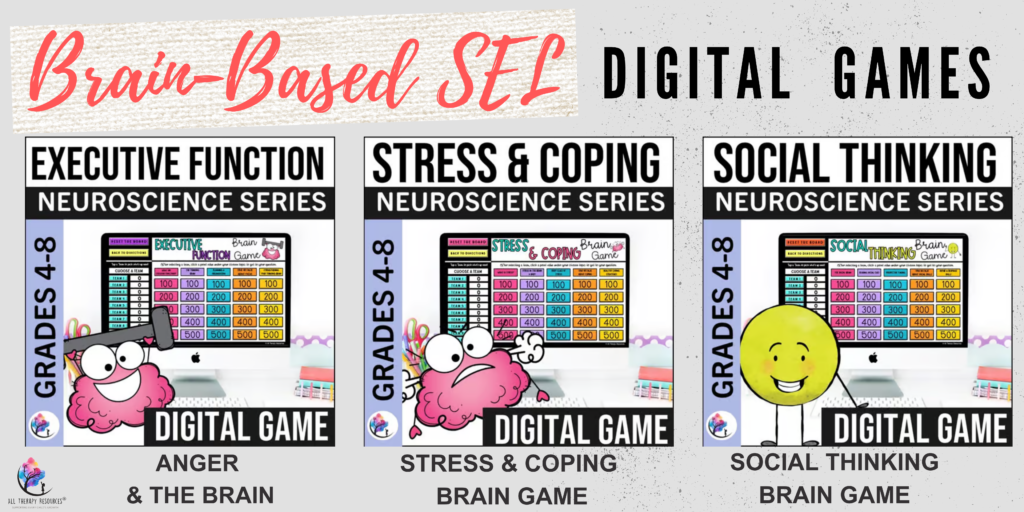
Stress and Coping (Regulation Systems)
They learn how stress impacts the brain and body, and how to activate calming strategies that support nervous system regulation.
Anxiety and the Brain (Cognitive-Emotional Awareness)
Students identify how anxious thoughts influence emotional and physiological responses—and how to intervene early.
Anger and Emotional Escalation (Impulse Control)
They explore triggers, emotional build-up, and how to interrupt reactive cycles using both cognitive and physiological strategies.
Social Thinking (Interpersonal Cognition)
Students develop perspective-taking, interpretation of social cues, and flexible thinking—key components of social-emotional competence.
Executive Functioning (Cognitive Control)
Skills such as planning, organization, working memory, and inhibition are explicitly developed and practiced.
Brain, Feelings, and Behavior Integration
Students begin to connect all domains—understanding that behavior is the result of interacting internal systems.
This is not surface-level SEL.
This is integrated, psychotherapy-informed skill development.
From My Counseling Room: What Changes When Students “Get It”
I’ve seen this shift countless times.
Students who once said:
“I don’t know why I did that.”
Start saying:
“My brain just reacted really fast.”
“I didn’t have time to think.”
“I needed to calm my body first.”
And this language matters.
Because language reflects cognition—and cognition drives change.
When students develop this level of insight:
- They pause more
- They reflect more
- They regulate more effectively
And importantly—they experience a reduction in shame.
Instead of seeing themselves as “bad” or “difficult,” they begin to see themselves as:
Learners.
Problem-solvers.
Individuals who can grow.
Trauma-Informed Practice: Why This Approach Is Essential
From a trauma-informed perspective, many students operate with heightened baseline stress.
This means:
- Faster threat detection
- Increased emotional reactivity
- Reduced access to the thinking brain
Traditional behavior-focused approaches can unintentionally reinforce shame or dysregulation.
But when we:
- Teach the brain
- Normalize responses
- Provide structured, engaging opportunities for reflection
We create psychological safety.
And safety is the foundation for learning, regulation, and growth.
What I Love About This Work
This is the kind of work that feels aligned with both clinical best practice and real-world impact.
It’s not about compliance.
It’s not about surface-level behavior change.
It’s about:
- Insight
- Understanding
- Skill-building
- Empowerment
I love approaches that help students make sense of themselves.
Because once that happens—everything else becomes possible.
Final Thoughts: Understanding Precedes Change
If we want students to regulate, we must first help them understand.
If we want behavior to shift, we must address the systems driving it.
And if we want long-term impact, we must move beyond telling students what to do—and start showing them why.
Because when students understand their brain, they gain:
Awareness.
Control.
Choice.
And that is where meaningful, lasting change begins.
FAQs
Why is neuroscience important in SEL?
Neuroscience helps students understand the biological basis of their emotions and behaviors, which increases self-awareness and supports regulation.
How does CBT connect to SEL?
CBT provides a framework for understanding the relationship between thoughts, emotions, and behaviors, which is central to SEL skill development.
What is psychoeducation and why is it important?
Psychoeducation involves teaching individuals about their internal processes. It reduces shame, increases insight, and improves engagement in behavior change.
Can students really understand brain-based concepts?
Yes. When presented in developmentally appropriate and engaging ways, students can quickly grasp and apply these concepts to real-life situations.
How does engagement impact emotional learning?
Higher engagement leads to deeper processing, better retention, and increased likelihood of applying skills in real-world contexts.
Is this approach suitable for trauma-affected students?
Yes. Teaching the brain and normalizing responses aligns with trauma-informed practice and supports safety, understanding, and regulation.