
Are you trying to teach gratitude to students — but wondering if it’s actually sinking in?
You introduce gratitude journals. You run kindness activities. You try reflection prompts. And yet some students still struggle with entitlement, negative thinking, peer conflict, or emotional regulation.
Here’s the truth:
Gratitude is not a “cute add-on” to social-emotional learning. It is a powerful protective factor for emotional regulation, executive functioning, resilience, and relationship-building.
When taught intentionally and developmentally, gratitude becomes a skill — not just a seasonal theme.
Let’s talk about what actually works.
Why Gratitude Is More Than Just Saying “Thank You”
Research in positive psychology consistently shows that gratitude supports:
• Emotional regulation
• Executive functioning
• Perspective-taking
• Reduced anxiety and depressive symptoms
• Stronger peer relationships
• Increased optimism and resilience
From a therapeutic lens, gratitude shifts attention. It builds cognitive flexibility. It strengthens neural pathways connected to positive recall and meaning-making.
But here’s the key:
Gratitude must be modeled, practiced, reflected on, and scaffolded developmentally.
One worksheet won’t do it.
One circle discussion won’t either.
Gratitude is built through layered experiences.
What Effective Gratitude Instruction Looks Like Across Age Groups
One of the biggest mistakes educators and therapists make is using the same gratitude approach for every age group.
Development matters.
Early Years (PreK–Grade 2)
Young children need concrete, visual, and creative entry points.
Hands-on crafts like:
• Gratitude bouquets
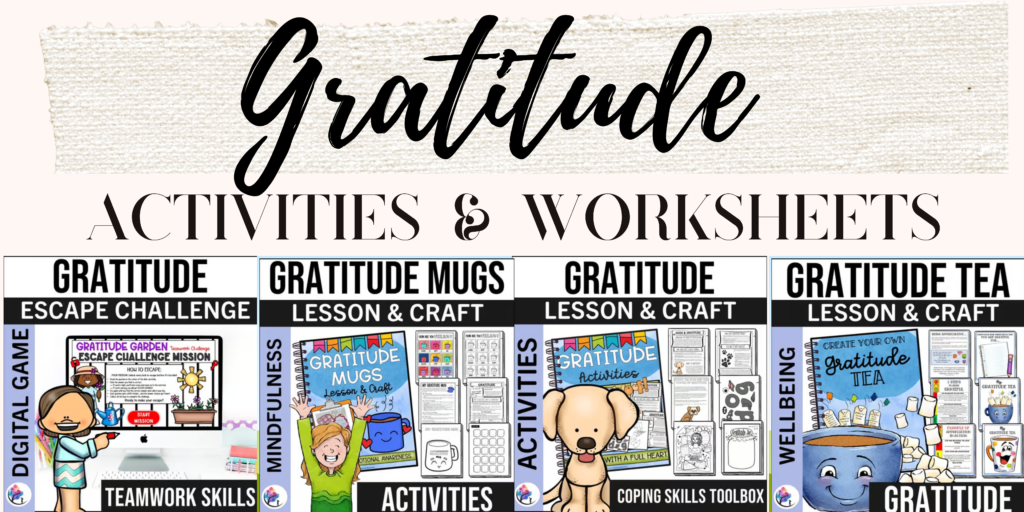
• Gratitude mugs
• Cut-and-paste gratitude lessons
These activities make abstract concepts tangible.
Our Gratitude Activities & 3D Bouquet Craft and Gratitude Mugs Lesson & Craft are perfect here because they combine:
• Emotional vocabulary
• Fine motor skills
• Reflection
• Play-based learning
When children build something physical to represent gratitude, they internalize it more deeply.
Elementary (Grades 2–5)
At this stage, students can begin to reflect more intentionally.
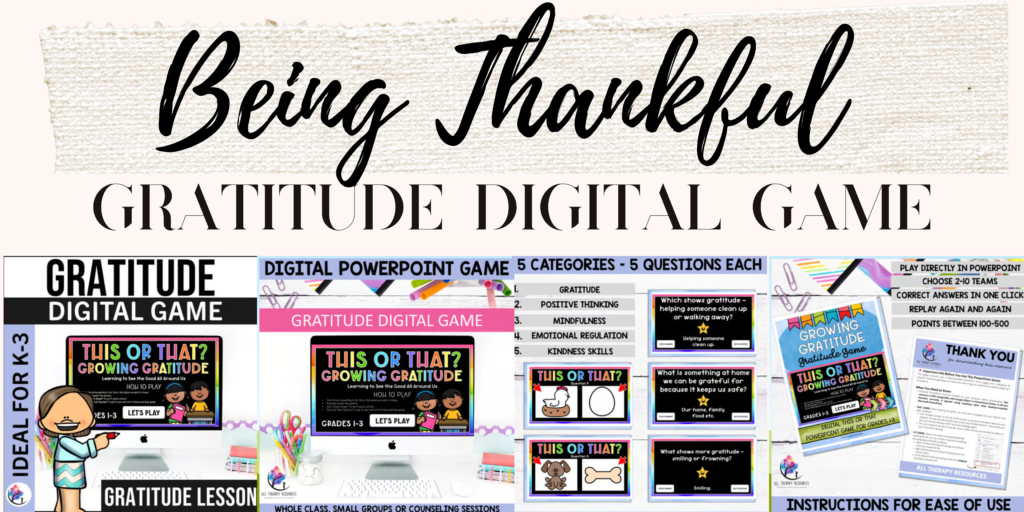
Interactive digital games like your Gratitude Garden Escape Challenge and Growing Gratitude This or That Digital Game build:
• Decision-making
• Executive functioning
• Reflection
• Perspective-taking
Game-based learning is powerful because it lowers resistance while increasing engagement.
Students practice gratitude in realistic scenarios — not just theory.
Your Gratitude Journal for Kids is also a beautiful structured tool here. Journaling builds:
• Self-awareness
• Emotional literacy
• Positive recall
• Cognitive reframing
Upper Elementary & Middle School
As students mature, gratitude becomes relational.
Our Gratitude & Appreciation Community Circles (Restorative Question Cards) help students:
• Reflect deeply
• Acknowledge impact
• Recognize acts of kindness
• Build school culture
Restorative gratitude work moves from “What am I thankful for?” to
“How does gratitude strengthen community?”
This is where gratitude becomes leadership.
Why Gratitude Strengthens Executive Functioning
This is the part that often gets missed.
Gratitude requires:
• Pausing
• Reflecting
• Perspective-taking
• Emotional regulation
• Memory recall
• Cognitive flexibility
In other words — gratitude strengthens executive functioning.
When students pause to identify something positive, they are interrupting reactive thought patterns.
Gratitude builds the “pause muscle.”
And we know from behavior and regulation research — the pause changes everything.
Get the Tea with Angie: What Actually Works
Here’s something I’ve learned over the years.
Gratitude cannot be forced.
If a child is dysregulated, overwhelmed, or living in survival mode, asking them to “just be thankful” can feel invalidating.
Gratitude must feel safe.
What I see work again and again is this:
- Build emotional safety first.
- Normalize all feelings before introducing positive reflection.
- Use concrete, creative tools.
- Keep it relational, not performative.
- Model gratitude authentically.
- Avoid shaming language (“You should be grateful”).
- Start small — one moment, one reflection.
- Connect gratitude to relationships.
- Revisit it consistently, not just seasonally.
- Celebrate growth gently.
Gratitude isn’t about toxic positivity.
It’s about helping children notice light without denying hard things.
And when done well — it becomes protective.
From Activities to Intervention: When You Need More Depth
For students struggling with:
• Persistent negativity
• Peer conflict
• Entitlement
• Emotional dysregulation
• Anxiety
• Low resilience
Gratitude work can move beyond classroom lessons into structured intervention.
That’s where layered approaches — digital games, journals, crafts, restorative circles — combined intentionally become powerful.
And this is exactly why we build resources across:
• Creative crafts
• Digital games
• Journals
• Restorative practices
• SEL lessons
• Community-building tools
You’re not limited to one method.
You can meet students where they are.
Why This Matters for School Culture
Gratitude is not just an individual skill.
When taught school-wide, gratitude supports:
• Reduced behavior referrals
• Stronger peer empathy
• Healthier classroom climates
• Increased student engagement
• Staff morale
It becomes culture.
And culture shifts outcomes.
If You Want Everything in One Place
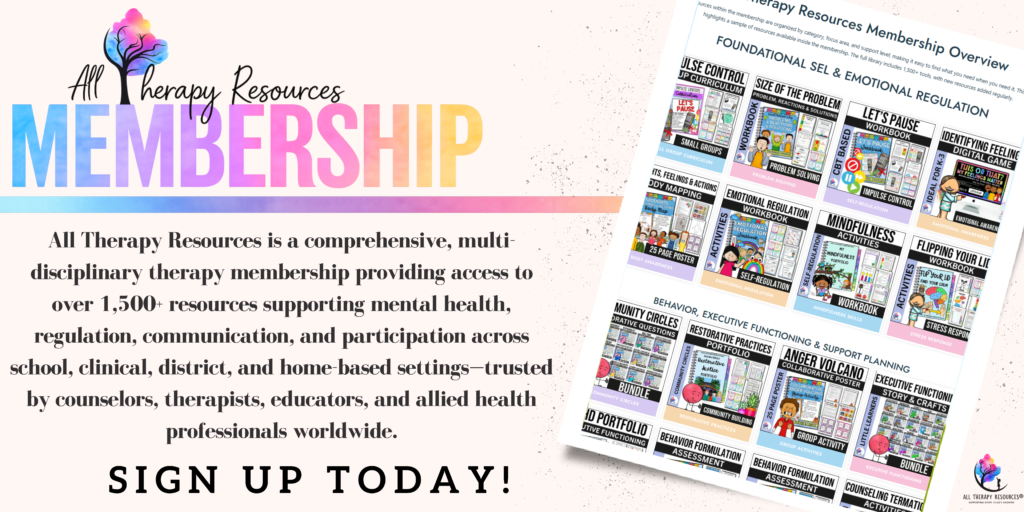
Inside the All Therapy Resources Membership, you’ll find:
• Gratitude lessons
• SEL activities
• Small group counseling curricula
• Executive functioning tools
• Behavior supports
• Emotional regulation resources
• Restorative practices
• Digital games
• Crafts and hands-on tools
Across all ages.
Because real-world practice requires flexibility.
And you deserve ready-to-use tools that are trauma-informed, evidence-informed, and developmentally appropriate.
Frequently Asked Questions
What age should gratitude instruction begin?
Gratitude can be introduced in early childhood through concrete, visual, and play-based activities. As children mature, instruction should become more reflective and relational.
How often should gratitude activities be used?
Consistency matters more than intensity. Brief, regular gratitude reflection is more effective than occasional large lessons.
Can gratitude improve behavior?
Gratitude strengthens executive functioning, emotional regulation, and perspective-taking — all of which support positive behavior outcomes.
Is gratitude appropriate for students experiencing trauma?
Yes — when introduced gently and paired with emotional validation. Gratitude should never dismiss hardship but can help build resilience when safety is established first.
If you’re teaching gratitude this year, you’re not just teaching manners.
You’re strengthening neural pathways.
You’re building resilience.
You’re shaping culture.
And that work matters deeply.