
Speech Therapy in Schools: Articulation Activities, Strategies, and Resources for Parents and Teachers
How can parents and teachers support students who struggle with speech sounds, language development, or communicating confidently in the classroom? Speech therapy in schools plays an important role in helping students develop the communication skills they need for learning, relationships, and everyday participation.
From articulation activities and speech sound practice to language-building games and interactive dramatic play, there are many ways to make communication practice meaningful, engaging, and accessible.
Understanding how school-based speech therapy works, and how to reinforce communication skills beyond therapy sessions, can help parents, teachers, and speech-language pathologists (SLPs) work together to support students.
What Is Speech Therapy in Schools?
School-based speech therapy supports students whose communication difficulties affect their ability to access learning, participate in classroom activities, or interact with others.
Speech-language pathologists assess and support a range of communication needs, including:
- Articulation: Producing individual speech sounds clearly and accurately.
- Phonological Skills: Understanding and using the sound patterns of spoken language.
- Receptive Language: Understanding spoken instructions, questions, and information.
- Expressive Language: Using words, sentences, and language to communicate ideas.
- Social Communication: Developing skills for conversations, interactions, and understanding social contexts.
- Fluency: Supporting students who experience stuttering or other disruptions to speech fluency.
- Augmentative and Alternative Communication (AAC): Supporting communication through tools such as picture systems, communication boards, or speech-generating devices.
The goal is not simply to improve how students pronounce words. It is to support functional communication, meaningful participation, and access to learning.
Understanding Articulation Difficulties in Children
Articulation refers to the physical production of speech sounds using the lips, tongue, jaw, and other speech structures.
Some children experience difficulty producing particular sounds, substituting one sound for another, or omitting sounds within words.
For example, a student might:
- Say “wabbit” instead of “rabbit.”
- Produce “tun” instead of “sun.”
- Have difficulty producing sounds such as /r/, /s/, /sh/, or /th/.
- Speak less clearly when using longer words or sentences.
- Avoid certain words because they are difficult to pronounce.
Some speech sound differences are developmentally expected, while others may benefit from assessment and targeted intervention.
Speech-language pathologists consider the child’s age, speech patterns, intelligibility, language background, and functional communication needs when determining whether support is appropriate.
Why Articulation Matters in the Classroom
Speech sound difficulties can affect more than pronunciation.
Some students may experience challenges when:
- Participating in oral presentations.
- Answering questions during classroom discussions.
- Communicating with unfamiliar adults or peers.
- Being understood during cooperative learning activities.
- Developing confidence in spoken communication.
Speech sound disorders may also coexist with difficulties in phonological awareness and literacy development, although this is not the case for every child.
Supporting articulation involves helping students develop accurate speech production while maintaining a positive, respectful communication environment.
How Does Speech Therapy Work in Schools?
School-based speech therapy typically begins with identifying communication concerns and determining whether a student requires additional support.
Depending on the educational system, this may involve teacher observations, parent consultation, screening, formal assessment, and consideration of educational impact.
Speech-language pathologists may provide support through:
- Individual Therapy: Targeted intervention based on specific communication goals.
- Small Group Sessions: Opportunities to practice communication skills alongside peers.
- Classroom-Based Support: Strategies and activities embedded within everyday learning.
- Teacher Consultation: Guidance for reinforcing communication skills in the classroom.
- Family Collaboration: Practical recommendations for supporting communication at home.
In the United States, eligibility for school-based speech-language services is determined through applicable special education procedures. A student does not necessarily qualify for school services solely because they have a speech sound difficulty.
Effective intervention is individualized, with goals selected according to assessment findings and the student’s educational and communication needs.
Articulation Activities for Speech Therapy in Schools
Articulation practice is often most effective when activities provide repeated opportunities to produce target sounds while maintaining student engagement.
The appropriate level of practice depends on the student’s individual goals. A child might begin by practicing a sound in isolation before progressing to syllables, words, phrases, sentences, and connected speech.
1. Articulation Cards for Targeted Sound Practice
Articulation cards provide a structured way to practice speech sounds through visual prompts and repeated production opportunities.
They can be incorporated into:
- Individual speech therapy sessions.
- Small group articulation activities.
- Picture-naming and sound identification tasks.
- Speech sound games and matching activities.
- Home practice recommended by an SLP.
For example, a student working on the /sh/ sound might practice words such as shoe, shell, and fish, with the therapist providing appropriate cues and feedback.
Ready-to-Use Articulation Resources
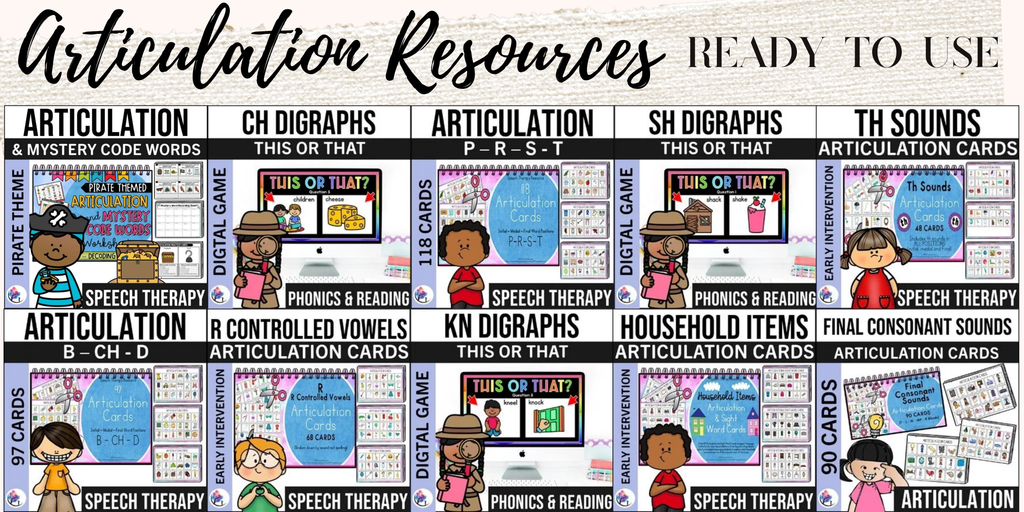
For therapists and educators looking to reduce preparation time, All Therapy Resources offers printable articulation cards and interactive speech sound activities covering a range of sounds and word patterns.
These include articulation cards for /r/, /s/, /sh/, /th/, consonant sounds, and everyday vocabulary, alongside engaging digital games.
Resources can be selected according to individual speech goals, helping make structured practice more accessible and engaging.
2. Interactive Speech Sound Games
Games can help transform repetitive articulation practice into an engaging learning experience.
Examples include:
- Picture-matching games using target speech sounds.
- This-or-that activities featuring speech sound vocabulary.
- Mystery word challenges.
- Sound sorting activities.
- Turn-taking games with articulation prompts.
Interactive activities can support motivation while providing opportunities for repeated practice.
However, games should complement rather than replace individualized speech-language intervention. The SLP remains responsible for selecting appropriate targets, providing corrective feedback, and monitoring progress.
Using Dramatic Play to Support Speech and Language Development
Dramatic play provides opportunities for children to practice communication within meaningful, imaginative situations.
Rather than focusing exclusively on isolated words, students can use language to ask questions, explain ideas, make requests, negotiate roles, and respond to others.
This makes dramatic play particularly valuable for supporting functional language development and social communication.
How Dramatic Play Can Support Communication
Depending on the activity and individual goals, dramatic play may encourage:
- Expressive Language: Naming objects, describing actions, and constructing sentences.
- Receptive Language: Following instructions and understanding questions.
- Vocabulary Development: Learning and using words associated with familiar or imaginative settings.
- Social Communication: Practicing turn-taking, requesting, responding, and conversational exchanges.
- Narrative Skills: Creating sequences, explaining events, and telling stories.
- Articulation Practice: Using previously established target sounds within meaningful words and phrases.
For articulation goals, the SLP can intentionally select vocabulary containing the student’s target sounds and provide appropriate opportunities for practice.
Dramatic Play Activity Ideas for Speech Therapy
Different dramatic play environments create opportunities to develop communication skills through purposeful interaction.
Students can practice asking questions, describing hairstyles, requesting services, and participating in conversational exchanges.
Role-play activities can involve purchasing tickets, requesting snacks, following directions, and practicing social interactions.
Students can describe objects, give instructions, sequence missions, and use imaginative vocabulary.
Children can describe insects, compare features, ask investigative questions, and develop scientific vocabulary.
Students can practice following directions, naming objects, asking questions, and using descriptive language.
These settings offer opportunities to integrate communication goals into purposeful play.
Ready-to-Use Dramatic Play Therapy Sets
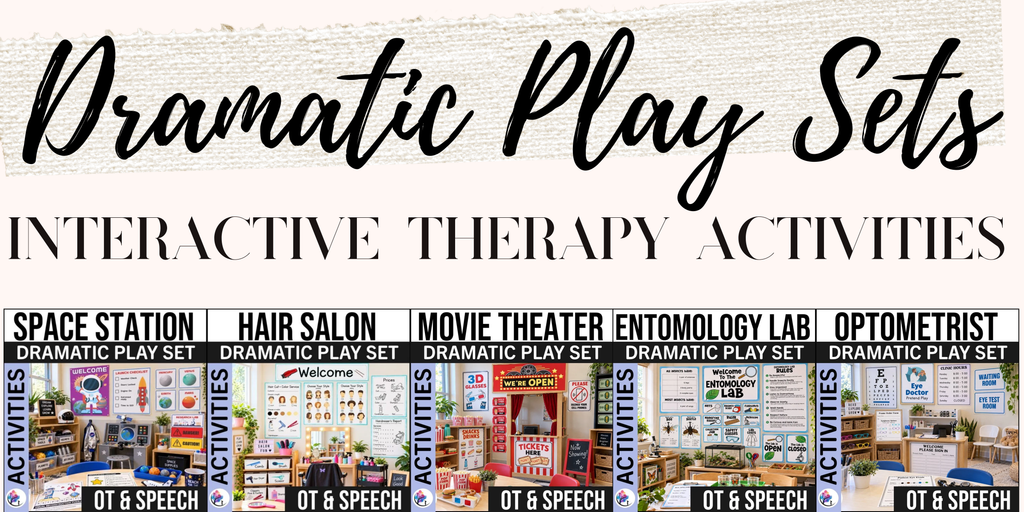
All Therapy Resources offers interactive dramatic play sets designed to support engaging learning experiences across speech-language and occupational therapy contexts.
The themed sets include opportunities for role-play, vocabulary development, fine motor participation, and functional communication.
For SLPs, educators, and therapists, these resources provide flexible environments that can be adapted to individual student goals without requiring extensive activity preparation.
Phonics and Speech Therapy: Understanding the Connection
Speech production, phonological awareness, and phonics are closely related areas of development, but each involves different skills.
Articulation focuses on how speech sounds are physically produced.
Phonological awareness involves recognizing and manipulating the sounds within spoken language, such as identifying rhymes, syllables, and individual phonemes.
Phonics focuses on the relationship between written letters and speech sounds.
A child may have articulation difficulties without experiencing literacy difficulties. Similarly, a child may experience phonological awareness difficulties despite producing speech sounds accurately.
Understanding these distinctions helps educators and therapists select activities that address the student’s actual learning needs.
Using Phonics Sound and Pattern Cards
Visual and movement-based phonics activities can support the development of sound–symbol knowledge and early literacy skills.
For example, students might:
- Identify letters and their corresponding sounds.
- Recognize common digraphs such as sh, ch, and th.
- Practice identifying sound patterns in familiar words.
- Combine visual, verbal, and movement-based learning experiences.
- Explore increasingly complex phonics patterns.
For students receiving speech therapy, these activities may complement broader literacy and phonological awareness goals when appropriately selected.
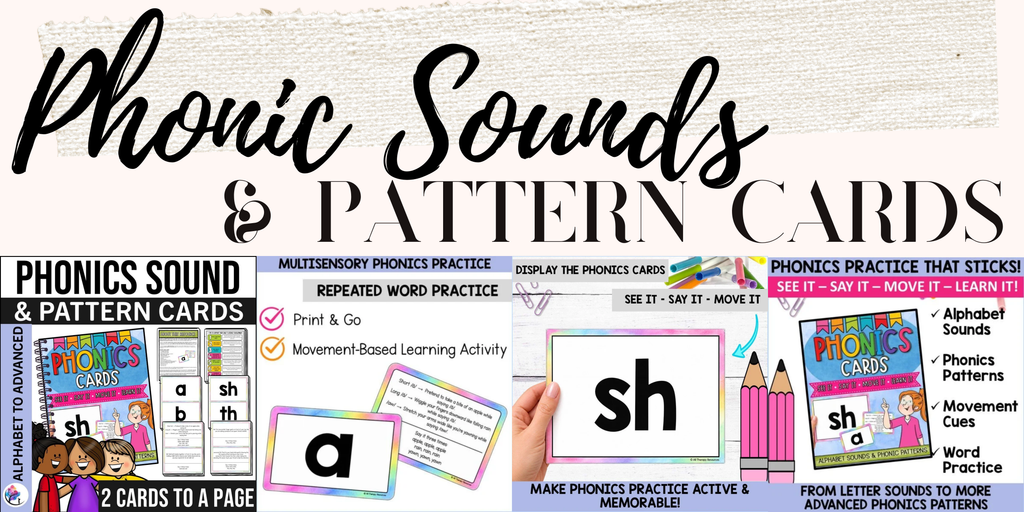
Our Phonics Sounds & Pattern Cards offer ready-to-use activities combining alphabet sounds, phonics patterns, movement cues, and word practice.
The cards provide opportunities for multisensory engagement and can be incorporated into classroom literacy activities, small group instruction, and targeted learning sessions.
Practical Speech Therapy Strategies for Teachers
Teachers play an important role in creating communication-supportive classrooms.
While direct speech-language intervention should be guided by qualified professionals, everyday teaching practices can help students participate more confidently.
Consider these strategies:
- Allow Processing Time: Give students sufficient time to understand questions and formulate responses.
- Model Clear Language: Use natural speech models without repeatedly interrupting or correcting students.
- Provide Visual Supports: Use pictures, written instructions, and demonstrations to reinforce understanding.
- Offer Multiple Ways to Respond: Allow verbal, written, visual, or AAC-supported communication where appropriate.
- Use Small Group Activities: Create supportive opportunities for communication and interaction.
- Collaborate With the SLP: Reinforce agreed-upon strategies and practice targets within classroom routines.
- Avoid Public Correction: Protect students from embarrassment or unnecessary pressure when speaking.
A supportive communication environment values what a student is communicating, not simply how accurately each word is pronounced.
How Parents Can Support Speech and Language Development at Home
Parents can reinforce communication development through everyday interactions without turning every conversation into a therapy session.
Practical strategies include:
- Reading books together and discussing pictures, characters, and events.
- Encouraging conversations during meals, shopping, and daily routines.
- Using imaginative play to explore new vocabulary.
- Modeling words and sentences naturally.
- Allowing children time to express themselves.
- Following speech practice recommendations provided by the child’s SLP.
- Recognizing effort and participation rather than expecting perfect speech.
For children working on articulation, short, targeted practice activities recommended by their speech-language pathologist may help reinforce newly developing skills.
It is important to avoid excessive correction or pressure, particularly when children are communicating spontaneously.
The goal is to make communication feel safe, meaningful, and enjoyable.
Supporting Speech Therapy Goals Through Collaboration
Successful school-based speech therapy involves more than the time a student spends in a therapy session.
Speech-language pathologists, teachers, families, and students can work together to support communication across different environments.
Collaboration may include:
- Sharing information about communication strengths and challenges.
- Identifying meaningful classroom participation goals.
- Selecting appropriate speech and language activities.
- Monitoring progress toward individualized goals.
- Adjusting strategies as communication skills develop.
When students have opportunities to apply communication skills across therapy, classroom activities, play, and home routines, those skills may become more functional and meaningful.
Final Thoughts: Making Communication Practice Meaningful
Speech therapy in schools plays an important role in helping students develop the communication skills they need to participate in learning and everyday interactions.
Whether a child is working on articulation, language development, phonological awareness, or social communication, effective support begins with understanding their individual strengths and needs.
Structured articulation activities, interactive speech sound games, phonics resources, and dramatic play experiences can each contribute to meaningful learning when selected for appropriate goals.
At All Therapy Resources, we believe therapeutic activities should be practical, engaging, and purposeful, helping professionals create opportunities for communication development without unnecessary preparation.
Because supporting communication is about more than producing individual sounds. It is about helping every student communicate, connect, and participate in ways that are meaningful to them.